Hazards in a chemical laboratory - types, examples and safety rules
Chemical laboratory hazards are mainly flammable, corrosive and toxic substances. Examples, safety rules from regulations and furniture that protects the lab.
 Renggli TeamEditorial team
Published: Updated Reading time: 10 min read
Contents
Hazards in a chemical laboratory come mainly from the properties of the reagents: flammability, explosivity, corrosivity and toxicity. The Rozporządzenie Ministra Zdrowia o czynnikach chemicznych (opens in a new tab) (the Polish Minister of Health regulation on chemical agents at work) requires risk to be reduced in a set order: from substituting the substance, through ventilation at the source, such as a laboratory fume hood, to personal protective equipment.
What are the chemical hazards in a laboratory, and what are some examples?#
A chemical hazard is a property of a substance that makes it capable of causing harm, for example by catching fire, exploding, burning the skin or poisoning. The chemical agents regulation (opens in a new tab) defines it as a property of a chemical agent and refers to the physical hazard and health hazard classes of the CLP Regulation. Hazard information is carried by the pictograms on the label and by the safety data sheet, as the European Agency for Safety and Health at Work (EU-OSHA) (opens in a new tab) explains.
Examples of chemical hazards in a typical laboratory:
- flammable substances: acetone, ethanol, diethyl ether, hexane; their vapours ignite from a spark or a hot plate;
- corrosive substances: concentrated sulfuric, nitric and hydrochloric acids, sodium and potassium hydroxides; they destroy skin and eyes on first contact;
- oxidisers: concentrated nitric acid, potassium permanganate, dichromates; they feed a fire and react with organic matter;
- toxic substances: cyanides, methanol, mercury and its compounds; they cause harm in small doses;
- carcinogenic and mutagenic substances: benzene, formaldehyde, hexavalent chromium compounds;
- explosive and unstable substances: azides, perchlorates, and the peroxides that form in ether stored for a long time;
- gases under pressure: cylinders of hydrogen, nitrogen, argon or acetylene.
Hydrofluoric acid is a case of its own: it is both corrosive and toxic, penetrates the skin and attacks glass.
How do chemicals harm health?#
Chemicals enter the body by three routes: through the respiratory tract, through the skin and through the digestive tract. In the laboratory, the main protection against inhaling vapours is the fume hood, because solvent and acid vapours rise above every open vessel.
Corrosive substances cause chemical burns to the skin and eyes. Alkalis dissolve tissue in depth (liquefactive necrosis), so the damage continues even after contact has ended. Toxic substances damage organs, while carcinogens and mutagens take effect after years of exposure, often without warning symptoms.
What other hazards are there in a chemical laboratory?#
Besides chemical hazards, a laboratory has physical, biological and ergonomic hazards. Physical hazards include cuts from broken glass, burns from burners and baths, electric shock at wet workstations, equipment noise and laser radiation. Biological hazards concern work with microorganisms and biological material. Ergonomic hazards come from long periods of work bent over a bench or a fume hood.
Clutter at the workstation increases each of these risks: it makes it easier to pick up the wrong reagent, spill something or knock over a vessel.
What are the health and safety rules in a chemical laboratory?#
Health and safety rules in a chemical laboratory follow from the order of measures set out in § 7 and § 8 of the chemical agents regulation (opens in a new tab). The first step is to try to replace a dangerous substance with a less dangerous one or with a different process; next, its release is limited, collective protection is applied at the source (for example ventilation) and work is organised accordingly. Personal protective equipment, that is a lab coat, goggles, gloves and a mask, is used when the hazard cannot be counteracted in any other way.
| Hazard | Example | Technical measure | Organisational measure |
|---|---|---|---|
| Toxic and irritant vapours | concentrated hydrochloric acid, ammonia, chloroform | fume hood, room ventilation | open vessels handled only inside the fume hood chamber |
| Flammable liquids | acetone, ethanol, hexane | fire safety storage cabinet, explosion-proof (Ex) fume hood | only the quantity needed for the analysis at the workstation, away from ignition sources |
| Corrosive substances | sulfuric acid, sodium hydroxide | acid and alkali cabinet with spill sumps, safety shower and eyewash | acid is poured into water, decanting over a tray |
| Volatile reagents without an extract duct | concentrated acids and alkalis in the chemical store | ventilated cabinet with a carbon filter | substance inventory and filter checks |
| Carcinogens | benzene, formaldehyde | fume hood, closed process | substitution with a less harmful substance, fewer people exposed |
| Hydrofluoric acid | digestion of mineral samples | fume hood with a polypropylene chamber | workstation instruction for this substance |
University laboratory rules translate these regulations into everyday habits. The health and safety rules of the Faculty of Chemistry at Nicolaus Copernicus University (UMK) (opens in a new tab) require, among other things:
- reading the safety data sheets before the practical and reading the label before using a reagent;
- working under a fume hood for all operations with concentrated acids;
- pouring acid into water, never the other way round;
- pipetting with a bulb or pump, never by mouth;
- collecting toxic and flammable substances in labelled containers instead of pouring them down the sink.
We cover work organisation in more detail in our article on how to ensure safety in a chemical laboratory.
What are the employer's duties when work involves chemical agents?#
The employer determines whether chemical agents posing a hazard are present in the laboratory and documents the occupational risk assessment. This is laid down in § 2 of the chemical agents regulation (opens in a new tab), and § 3 requires the assessment to be in writing. Among other things, the assessment takes into account the hazardous properties of the substances, the supplier's safety data sheet, the level and duration of exposure, and the quantities of reagents used.
The assessment is repeated after a change in the composition of the chemical agent or in the technological process (§ 4). A new activity involving a chemical agent may start only after the risk has been assessed and preventive measures have been taken (§ 5).
The assessment needs data from the label and the safety data sheet. A CLP label contains pictograms, a signal word, H statements (type of hazard) and P statements (precautionary measures), as summarised by the Provincial Sanitary and Epidemiological Station in Poznań (opens in a new tab).
How should you respond to a spill, chemical burn or fire?#
In the event of a spill, burn or fire, staff follow emergency procedures that the employer must define and put in place beforehand. § 11 of the chemical agents regulation (opens in a new tab) requires them to cover periodic rescue drills, rescue equipment and facilities, and first aid rules. After an incident, only essential and authorised persons wearing suitable protective equipment remain in the area (§ 12).
How the room should be equipped is described in the CIOP-PIB guidelines on chemical agents (opens in a new tab) (CIOP-PIB is the Polish Central Institute for Labour Protection). Rooms for work with flammable, explosive or highly toxic materials should have hazard signalling, firefighting equipment, first aid kits with neutralising agents, and collective and personal protective equipment.
In the case of a chemical burn, the contaminated area is rinsed immediately and for a long time with plenty of water, and contaminated clothing is removed. A spill is reported at once to the person responsible for the laboratory. Leaks in the chemical store are prevented by separating reagents by hazard, as we describe in our article on how to organise the storage of hazardous substances.
Which laboratory furniture reduces chemical hazards?#
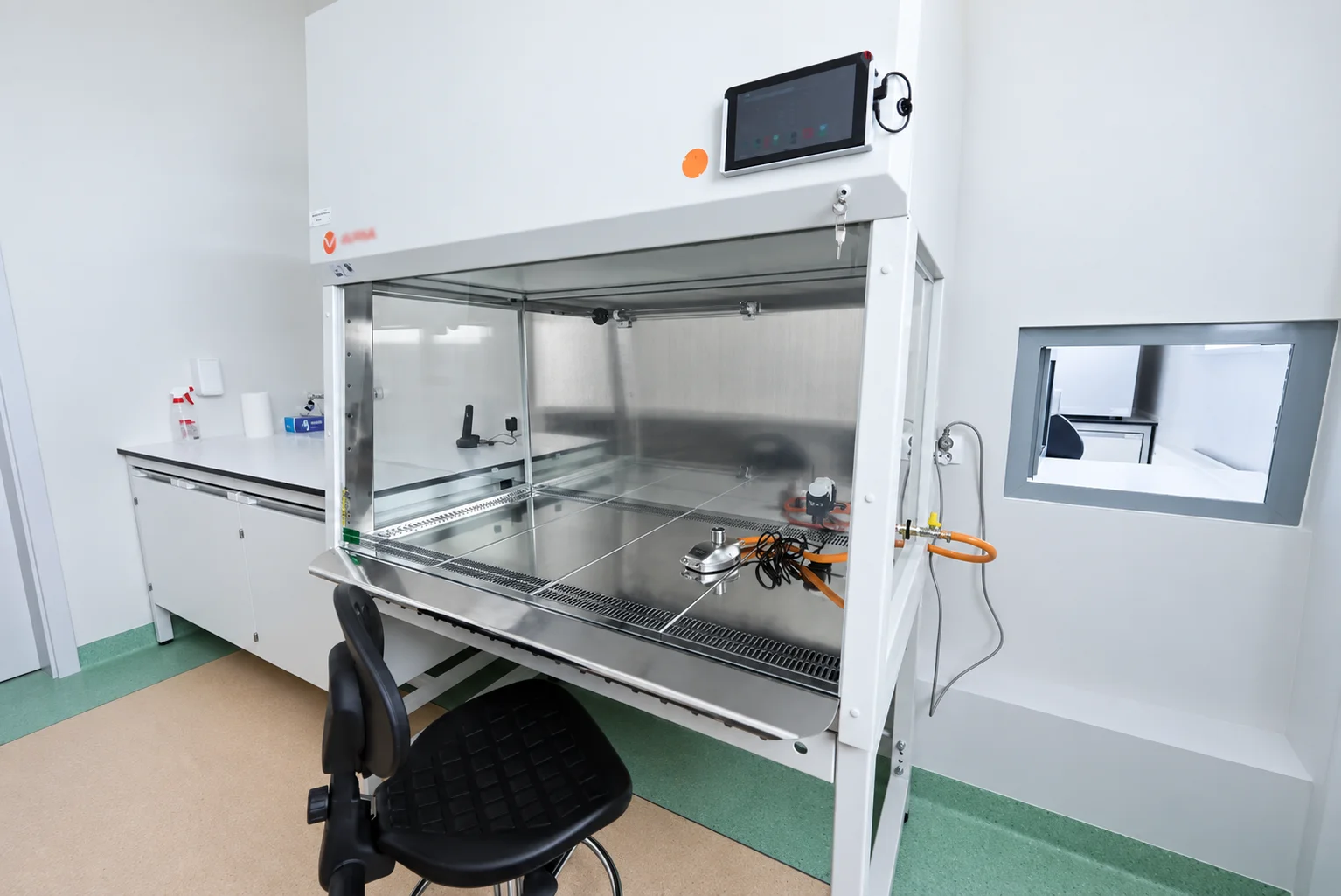
Chemical hazards are reduced above all by the fume hood and chemical storage cabinets, because they contain vapours and liquids at the source. According to the CIOP-PIB guidelines (opens in a new tab), equipment in which chemical substances are processed should be hermetically sealed. Where this is not possible, local exhaust ventilation is used, and in a chemical laboratory the fume hood is an example of it.
The LabAirTec fume hoods we offer draw air in through the sash opening at a face velocity of 0.3 to 0.5 m/s. The requirements for fume hoods are set out in EN 14175. The VAV (variable air volume) system matches the airflow to the sash opening and triggers an alarm when the velocity falls below the threshold. The service valves sit on an external panel, so the operator can shut off the gas without reaching into the chamber. For hydrofluoric acid we make chambers entirely of polypropylene, and for flammable substances we make explosion-proof (Ex) versions.
Our range of laboratory cabinets includes 30-minute and 90-minute fire safety storage cabinets to EN 14470-1, whose doors close automatically in a fire. Acid and alkali storage cabinets to EN 16121 have a corrosion-resistant interior and spill sumps. Where there is no extract duct, a ventilated cabinet cleans the air with an activated carbon filter; it is intended for volatile but non-flammable substances.
When ordering, it helps to provide a list of reagents with their quantities and to state whether the room has an extract duct. These determine the chamber material, the fume hood version and the type of cabinet. How the fume cupboard, the worktops, reagent storage and chemical drainage fit together in one room is shown on our page about equipping a chemistry laboratory.
Frequently asked questions#
Typical examples are flammable solvent vapours (acetone, diethyl ether), burns from concentrated acids and alkalis, poisoning by methanol or mercury compounds, and exposure to carcinogens such as benzene and formaldehyde. Added to these are oxidisers, which feed a fire, and gases in pressurised cylinders.
A chemical hazard is a property of a substance that can cause harm, for example a fire, explosion, burn or poisoning. Risk is the likelihood that the harm will occur under specific working conditions. The employer assesses it in writing, as required by the chemical agents regulation (opens in a new tab).
Before starting work, read the safety data sheet and the reagent label, and handle concentrated acids and volatile substances in a fume hood. Pour acid into water, pipette with a bulb, and collect toxic and flammable waste in labelled containers. A lab coat, goggles and gloves supplement collective protection but do not replace it.
A laboratory has chemical, physical, biological and ergonomic hazards. Chemical hazards come from the properties of reagents, physical ones from glass, heat, electricity, noise and lasers, biological ones from work with microorganisms, and ergonomic ones from awkward body postures.
Reagents are separated by hazard: flammable liquids go in a fire safety storage cabinet, acids and alkalis in a cabinet with a corrosion-resistant interior, and volatile substances in a ventilated cabinet. Containers are placed in spill sumps and labelled. We give the details in our article on how to store chemical reagents in a laboratory.