Why is proper fume hood ventilation so important?
A fume hood is the central point of almost every modern chemical, analytical, or biological laboratory. It is the place where most processes involving the risk of hazardous substance emissions are performed.
 Renggli TeamEditorial team
Published: Updated Reading time: 5 min read
Contents
The Key Role of a Fume Hood in a Modern Laboratory#
A fume hood is the central point of almost every modern chemical, analytical, or biological laboratory. It is the place where most processes involving the risk of hazardous substance emissions are performed.
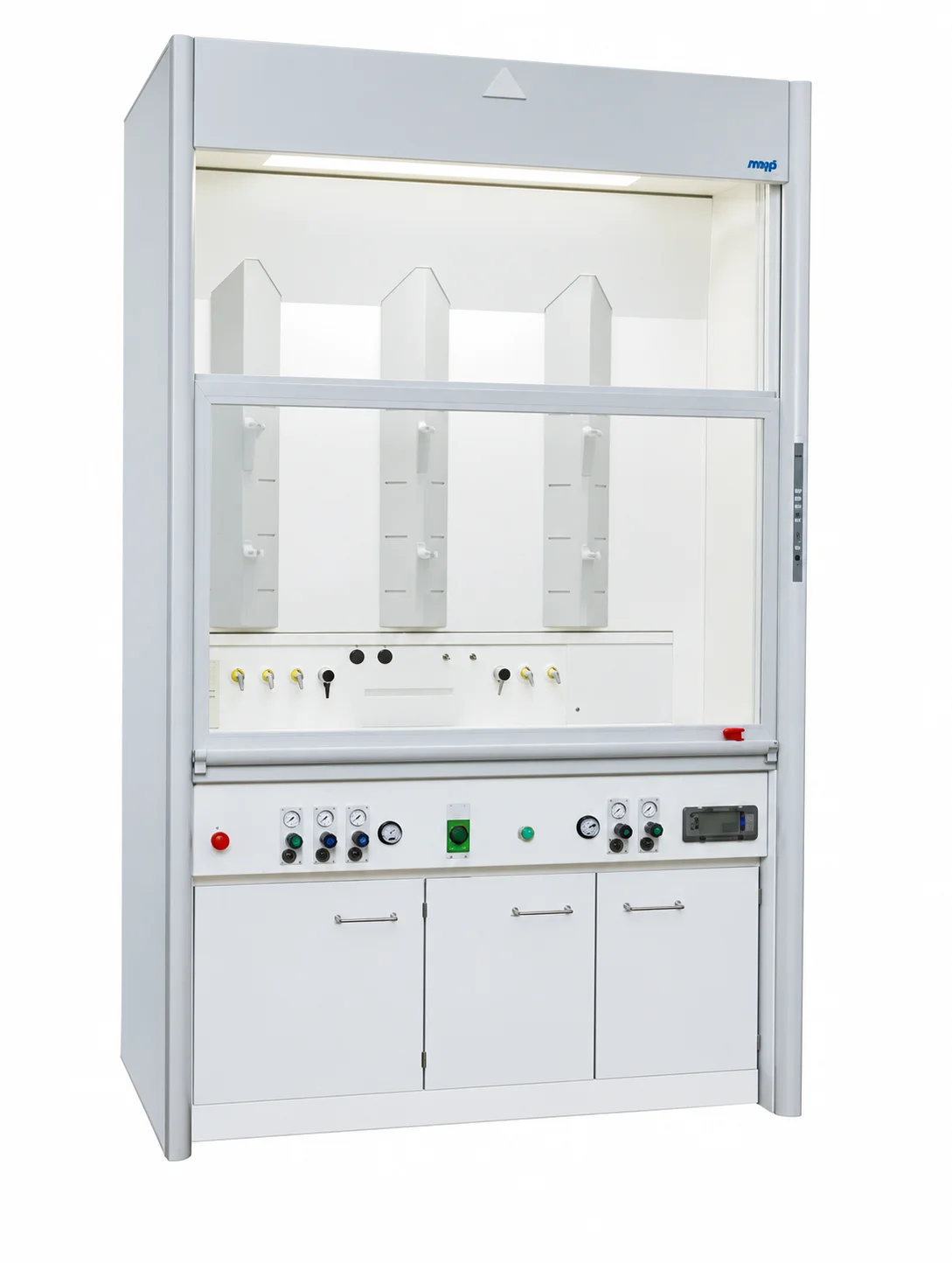
However, it is worth noting that a fume hood is not merely a piece of interior equipment. Unlike standard laboratory furniture, it serves as an advanced protective device designed to isolate the user and the environment from hazardous factors.
The heart of every fume hood, regardless of its design, size, or intended use, is the ventilation system. It is precisely on its efficiency, precision, and control method that not only the daily comfort of the personnel depends, but above all, their health and occupational safety.
Laboratory Personnel Safety as an Absolute Priority#
The primary function of fume hood ventilation is to protect the operator from direct contact with toxic vapors, corrosive gases, aerosols, or dusts generated during work with chemical reagents. A properly balanced airflow ensures that all harmful substances are effectively removed from the working chamber before they reach the employee's breathing zone.
A key role here is played by the so-called air curtain, which is an air stream formed in the plane of the working sash. It acts as an invisible barrier, preventing contaminants from escaping outside the chamber, even during dynamic movements performed during an experiment. The physical barrier remains the fume hood sash itself, which, in combination with an appropriate air stream, creates a tight, controlled protective system.
No less important is preventing the formation of explosive mixtures. When working with volatile substances, a lack of adequate air exchange can lead to a dangerous increase in vapor concentration in the working chamber. Continuous, properly designed ventilation eliminates this risk by keeping the substance concentration well below the lower explosive limit.
Protection of Tested Samples and Analytical Process Stability#
Fume hood ventilation does not only serve to protect the operator; it is also of key importance for the quality and repeatability of the conducted research results. Properly designed aerodynamics inside the working chamber prevent cross-contamination, i.e., the transfer of volatile substances between different samples located in the working area simultaneously.
A smooth, laminar airflow minimizes the risk of turbulence that could disrupt delicate analytical processes. This is of particular importance in activities requiring the highest precision, such as weighing substances on analytical balances (even slight air swirls can affect the accuracy of mass measurement).
Operational Cost Optimization and Energy Efficiency#
The operation of a fume hood involves the continuous removal of air from the inside of the building, which was previously heated or cooled, and then irreversibly released into the atmosphere. On the scale of an entire laboratory, especially one equipped with multiple extraction stations, this generates significant and constantly growing energy costs.
Traditional ventilation systems, operating at a constant, maximum flow rate regardless of the current use of the fume hood, lead to unnecessary energy waste. Conversely, a properly designed and intelligently controlled installation allows for reducing the amount of extracted air when the device is not fully loaded, for example, when the working sash is partially closed or the fume hood remains temporarily unused.
The effect of such an approach is measurable and visible directly in the research facility's bills. Lower electricity consumption needed to drive fans and reduced heating or air conditioning costs for make-up air translate into real operational savings over a multi-year perspective.
Innovative VAV Systems in Renggli Solutions#
The answer to the need to combine safety with energy efficiency are VAV (Variable Air Volume) systems, i.e., solutions based on a variable volume of air. Renggli fume hoods can be integrated with this type of installation, which allows for dynamic adjustment of the extraction force to current working conditions.
The VAV system automatically regulates the airflow depending on the degree of opening of the fume hood sash. The wider the sash is open, the greater the required air stream, and vice versa. Such a rapid system response increases the level of safety, because ventilation parameters are constantly adjusted to the actual threat.
At the same time, this solution drastically reduces energy consumption compared to constant air volume systems. This fits into the growing trend of sustainable laboratory development, known as Green Lab, which involves minimizing the environmental impact of research facilities while maintaining the highest working standards.
Compliance with Strict Safety Standards (EN 14175)#
Properly functioning fume hood ventilation is, above all, a significant legal requirement. Laboratory fume cupboards used in the European Union must meet the requirements specified in the EN 14175 standard, which regulates, among other things, the testing methodology and technical parameters that an efficiently operating device must meet.
This standard specifies the procedures for testing ventilation effectiveness, including methods for assessing the tightness of the working chamber and airflow stability under various operating conditions. Meeting these requirements is the basis for approving a fume hood for use in a professional laboratory.
Invest in Proven Ventilation Systems#
Fume hood ventilation is much more than a technical detail of a laboratory installation. As the above analysis shows, it is an element that simultaneously determines personnel safety, the precision of conducted research, and the operational costs of the entire facility.
Investment in proven, properly designed ventilation systems translates into measurable benefits in each of these areas, from employee health protection, through the stability of analytical results, to real energy savings in the long term.