What is a fume cupboard (fume hood) and how does it work?
A fume cupboard, or fume hood in the US, keeps fumes away from the user. How it works, the main types, what BS EN 14175 covers and how often to test it.
 Renggli TeamEditorial team
Published: Updated Reading time: 7 min read
Contents
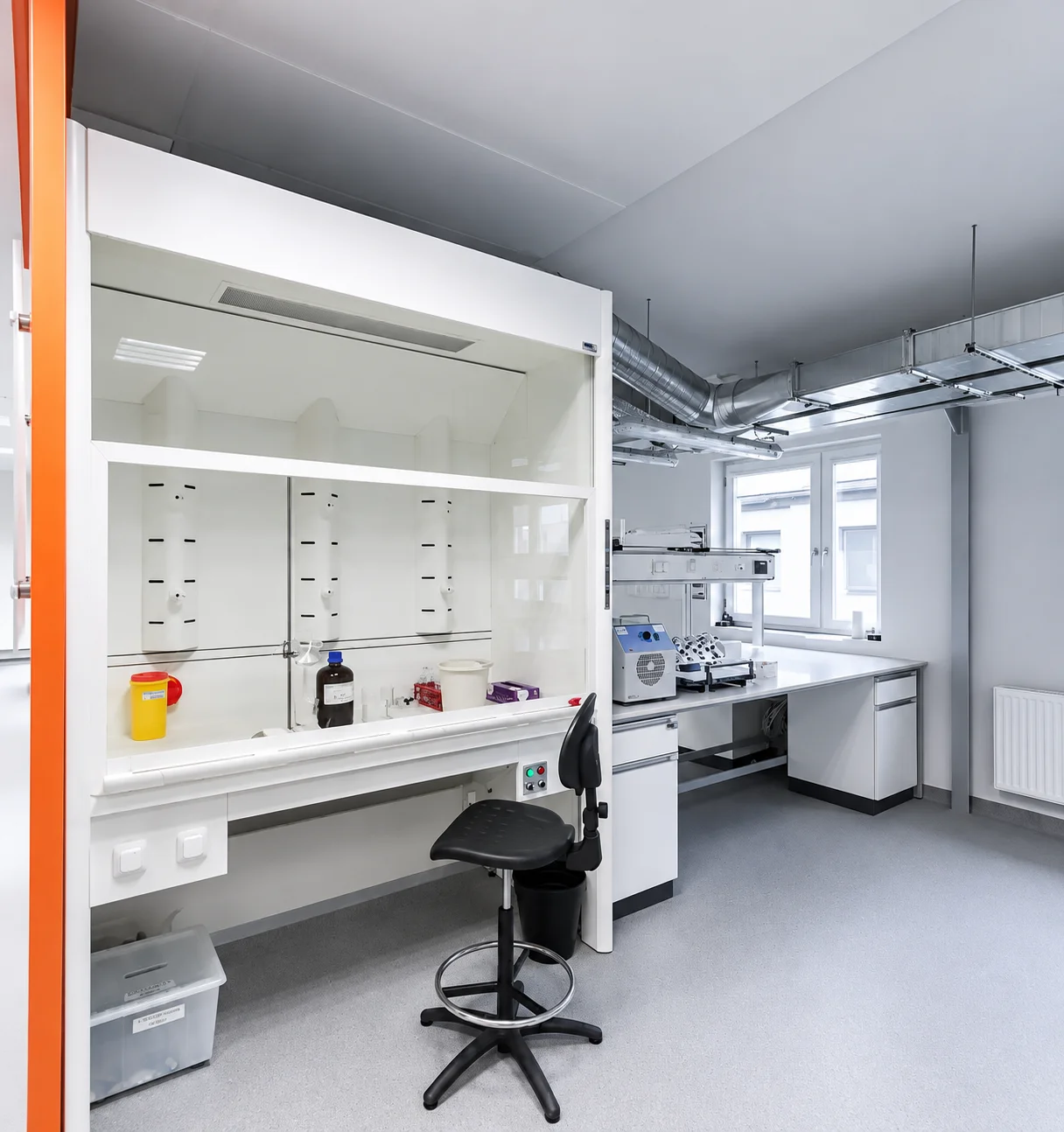
A fume cupboard, called a fume hood in American English, is a ventilated enclosure for laboratory work with hazardous substances. Air is drawn in under a sliding glass sash and extracted, so gases, vapours and dust stay inside, away from the user's breathing zone. In the UK and the rest of Europe, fume cupboards are designed and tested to BS EN 14175; our laboratory fume cupboards come in ducted and ductless versions.
Fume cupboard or fume hood: is there a difference?#
There is no difference: both names describe the same device. British English and the European standard use “fume cupboard”, as in the title of BS EN 14175-2 (opens in a new tab), while American suppliers say “fume hood”. The German statutory accident insurance guide DGUV Information 213-857 (opens in a new tab) lists the same pair: “fume cupboards” in English, “fume hoods” in American usage.
Across Europe the same device appears as Laborabzug or Digestorium in German, dygestorium in Polish, витяжна шафа in Ukrainian and traukos spinta in Lithuanian.
What does a fume cupboard protect against?#
A fume cupboard protects the person at the bench from airborne hazardous substances. DGUV Information 213-857 (opens in a new tab) gives it three aims:
- keep gases, vapours and airborne particles inside the chamber, so they do not reach the room in a hazardous concentration;
- prevent an explosive atmosphere from building up inside the chamber;
- shield the user from splashes and flying glass when an apparatus fails.
The first aim, containment, is what the tests in BS EN 14175 measure. A fume cupboard does not protect the sample: a laminar flow cabinet or a microbiological safety cabinet does that job. When a simple extraction arm is enough instead, see our post on laboratory fume extraction.
How does a fume cupboard work?#
A fan in the exhaust system pulls air through the chamber all the time. Room air enters under the sash and through openings at the front, rolls inside the chamber and leaves at the rear baffle, carrying the contaminants with it. DGUV Information 213-857 (opens in a new tab) describes this roll of air and notes that it also dilutes flammable vapours.
Three things decide whether containment holds:
- Sash position. The lower the sash, the smaller the opening the air has to protect. Working through the side panes of a split sash keeps the opening small.
- Airflow monitoring. An indicator or alarm shows when the airflow falls below the set level. HSG258 (opens in a new tab) refers to BS EN 14175 for this kind of alarm.
- Make-up air. Every cubic metre extracted has to be replaced. According to HSG258 (opens in a new tab), without planned replacement air severe draughts develop and the LEV does not perform as designed.
The airflow a fume cupboard needs comes from its type test. For three Renggli AG bench fume cupboards, the EN 14175-3 type test at the independent Tintschl laboratory in Erlangen gave these values:
| Model | Width (mm) | Exhaust airflow (m³/h) | Face velocity (m/s) |
|---|---|---|---|
| T120 | 1,200 | 480 | 0.34 |
| T150 | 1,500 | 600 | 0.27 |
| T180 | 1,800 | 720 | 0.27 |
How to work out the airflow for a given sash opening is shown in our post on fume cupboard airflow calculation.
What types of fume cupboard are there?#
The general purpose bench fume cupboard covers routine work; the other types answer a specific task. The table lists the common ones with the standard that describes each.
| Type | Where it fits | Standard |
|---|---|---|
| Bench fume cupboard | routine work with solvents, acids and alkalis | EN 14175-2, -3, -4 |
| Floor-standing (walk-in) fume cupboard | tall apparatus, frames, equipment on trolleys | EN 14175 series |
| Variable air volume (VAV) fume cupboard | buildings where extract air and heating costs matter | EN 14175-6 |
| Fume cupboard for high heat and acid load | acid digestion, perchloric acid work | EN 14175-7 |
| Ductless (recirculating filtration) fume cupboard | rooms without an exhaust duct, a known and limited list of substances | EN 17242 |
A scored comparison of fume cupboard types on cost, installation and the range of substances is in our guide.
Ducted or ductless: which one do you need?#
A ducted fume cupboard suits any laboratory that can run an exhaust duct, because it removes the contaminated air from the building. Our ducted fume cupboards are delivered with exhaust ductwork prepared for connection; the extract fan belongs to the building's ventilation and is outside our scope of supply.
A ductless fume cupboard cleans the air with filters and returns it to the room, so it works where a duct cannot be installed. HSG258 (opens in a new tab) says a recirculating fume cupboard used for dust, mist or fume should have a HEPA filter and continuous monitoring. Recirculatory filtration units are outside the scope of BS EN 14175-2 and are covered by EN 17242 (opens in a new tab), published in 2025. In our range this role is filled by the ductless LabAirTec Green.
Which standards and checks apply in the UK?#
In the UK, fume cupboards are designed and tested to BS EN 14175, and in use they count as LEV under COSHH. The Control of Substances Hazardous to Health Regulations 2002 (opens in a new tab) put control of exposure at source, “including adequate ventilation systems”, ahead of personal protective equipment.
COSHH regulation 9 (opens in a new tab) requires a thorough examination and test of LEV at least once every 14 months. The processes listed in Schedule 4 need shorter intervals. For partial enclosures such as fume cupboards, HSG258 (opens in a new tab) asks for face velocity readings, and further tests to the appropriate British or European standard.
BS EN 14175 has separate parts for terms, requirements, type tests, on-site tests, VAV and special fume cupboards. The full list, with the certificates and test reports we provide, is on our standards page. How often each test is due and who carries it out is covered in our guide to fume cupboard testing.
What to check when ordering a fume cupboard#
Start from the work, not the catalogue: the substances, their quantities, any heat sources and the height of the apparatus decide the type and the airflow. Then check:
- the EN 14175-3 type test report for the model, with the exhaust airflow it was tested at;
- whether the room's supply air can replace that airflow without draughts at the sash;
- the airflow alarm and how it signals a fault;
- for ductless units, which substances the filter is approved for and how filter saturation is detected.
Renggli AG issued a declaration of conformity in 2015 for its Euro II and LabAirTec fume cupboards, covering EN 14175 parts 1 to 6. After installation, our service responds to a call within 48 hours.
Frequently asked questions#
Yes. “Fume cupboard” is the British and European standard term, “fume hood” the American one, and both mean a ventilated enclosure with a sliding sash.
It is used for any work that releases hazardous gases, vapours or dust: handling solvents, acids and alkalis, heating reagents or running reactions. The airflow keeps these substances away from the user's breathing zone.
COSHH requires a thorough examination and test of LEV, which includes fume cupboards, at least once every 14 months. Some processes listed in Schedule 4 of COSHH need shorter intervals.
No. A ductless fume cupboard filters the air and returns it to the room, so it suits laboratories where a duct cannot be installed and the list of substances is known.