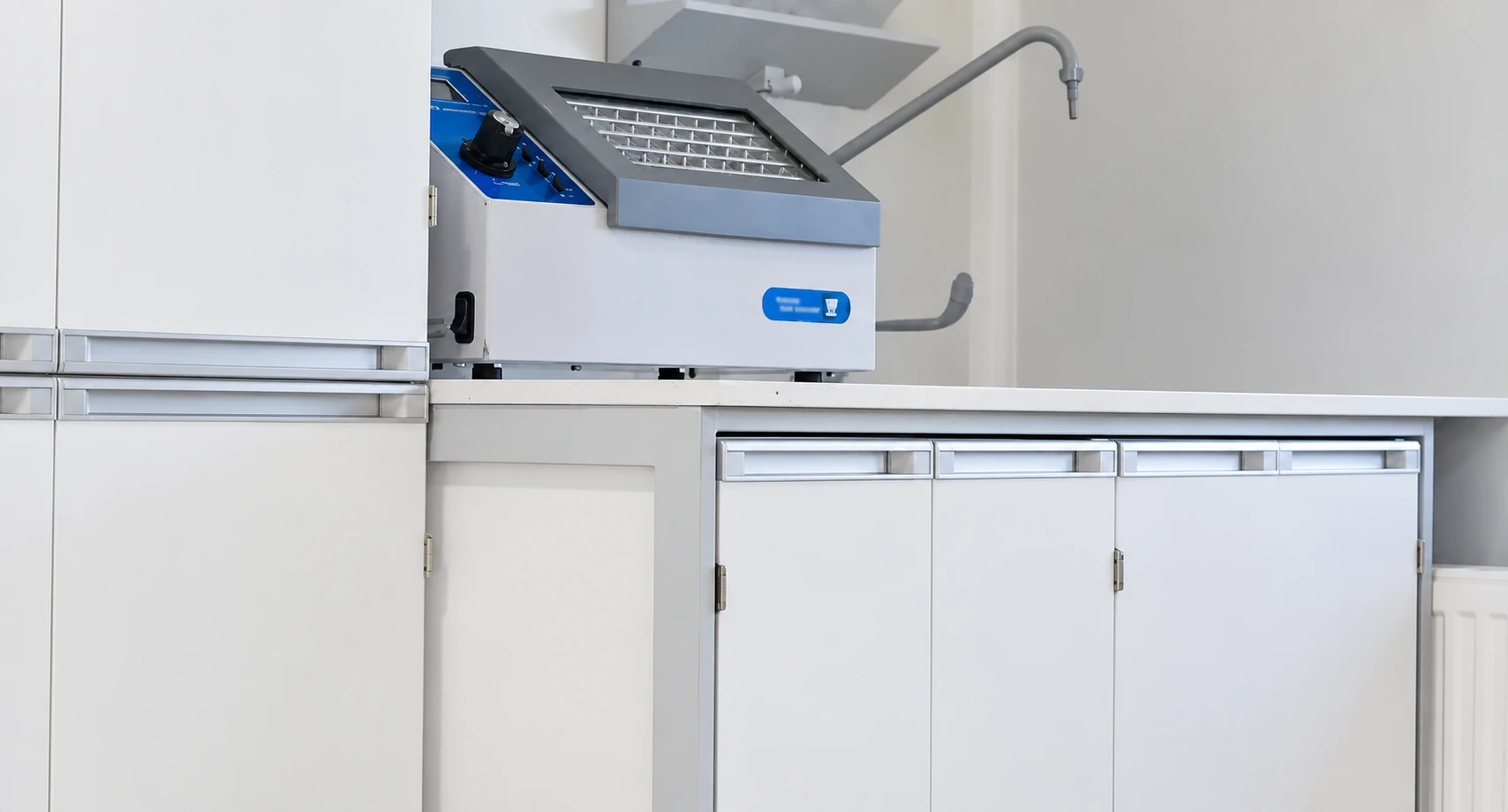
Pharmaceutical Laboratory Furniture
Furniture for a pharmaceutical laboratory has to be easy to clean and disinfect. It must withstand the reagents used in analysis and allow the layout to change when the scope of testing changes. Renggli designs it within the modular RL system, manufactures it in Białystok to ISO 9001:2015 and installs it with its own team. The same team supplies laboratory fume hoods (fume cupboards), cabinets and the laboratory's support facilities.
Furniture requirements in pharmaceutical laboratories
A pharmaceutical laboratory, including a quality control laboratory, works to good manufacturing practice (GMP) requirements and to the company's own procedures. For furniture, this means smooth surfaces with no gaps, materials that withstand cleaning and disinfecting agents, and a layout that can be described in the qualification documentation. On larger projects the governing document is the user requirements specification (URS). For fume hoods, the review covers installation qualification (IQ) and operational qualification (OQ). GMP requirements are covered in our article on pharmaceutical laboratory equipment.
Surfaces and materials
The worktop is chosen to suit the reagents and temperatures at each workstation. Monolithic ceramic is 20 mm thick and withstands 98% sulphuric acid and 65% nitric acid. Epoxy resin absorbs less than 0.05% water and can be used continuously at up to about 180 °C. HPL laminate is about 60% lighter than ceramic. AISI 304 and AISI 316L stainless steel suits areas where hygiene and frequent cleaning matter. The frames are steel sections, powder-coated with epoxy resin. All worktop materials are listed under laboratory worktops. Our article on ISO standards for laboratories explains how equipment affects accreditation and audits.
Fume hoods and cabinets
LabAirTec fume hoods are used in chemical, biological, pharmaceutical and industrial laboratories and comply with EN 14175. Biological and pharmaceutical laboratories choose a stainless steel chamber because it is easy to sterilise. Each fume hood needs a technical inspection at least once every 12 months. The inspection includes a smoke test, airflow measurement with an anemometer, an alarm check and sensor calibration.
Solvents and other flammable liquids are stored in fire-resistant safety storage cabinets that comply with EN 14470-1 and are rated for 30 or 90 minutes. Acids and alkalis go in cabinets that comply with EN 16121 and EN 16122. The standards worth including in a specification are listed on our laboratory furniture standards page.
Changing rooms and support areas
We design office space, staff facilities and changing rooms together with the laboratory, so the whole facility is built to one system. The furniture for these areas is our office furniture, made in the same factory. One example is the changing rooms at laboratories in Warsaw: 3 rooms, 22 m², made-to-measure furniture installed by our own team.
Projects
- Pharmaceutical laboratory in Warsaw: 4 rooms, 168 m², furniture from our modular RL laboratory furniture system, designed and built to fit the layout of these rooms.
- Changing rooms at laboratories in Warsaw: 3 rooms, 22 m².
Frequently asked questions
The material is chosen to suit the reagents and temperatures at each workstation. Monolithic ceramic is used for concentrated acids and epoxy resin where a seamless surface matters. Stainless steel suits areas where frequent cleaning comes first, and HPL laminate is used for lighter-duty work.
Yes. LabAirTec fume hoods are used in pharmaceutical and industrial laboratories. They come in free-standing, benchtop, walk-in and twin-chamber versions. An explosion-proof (Ex) version is available for explosion hazard areas, and a stainless steel chamber is chosen because it is easy to sterilise.
Yes, we design office and staff areas together with the laboratory itself. You don't pick from a catalogue. Instead, we prepare a design for the specific room, workstation layout and budget.
Stay up to date with Renggli
New projects, products and guides on laboratory furniture, in one place.
Let us plan your laboratory
Tell us what has to happen in the room. We will pick the furniture and work out the rest.
Free project quote.