Carbon filter fume hood or extraction type?
A carbon filter fume hood cleans the air and returns it to the room, an extraction one vents fumes outside. When to choose which, and what standards?
 Renggli TeamEditorial team
Published: Reading time: 8 min read
Contents
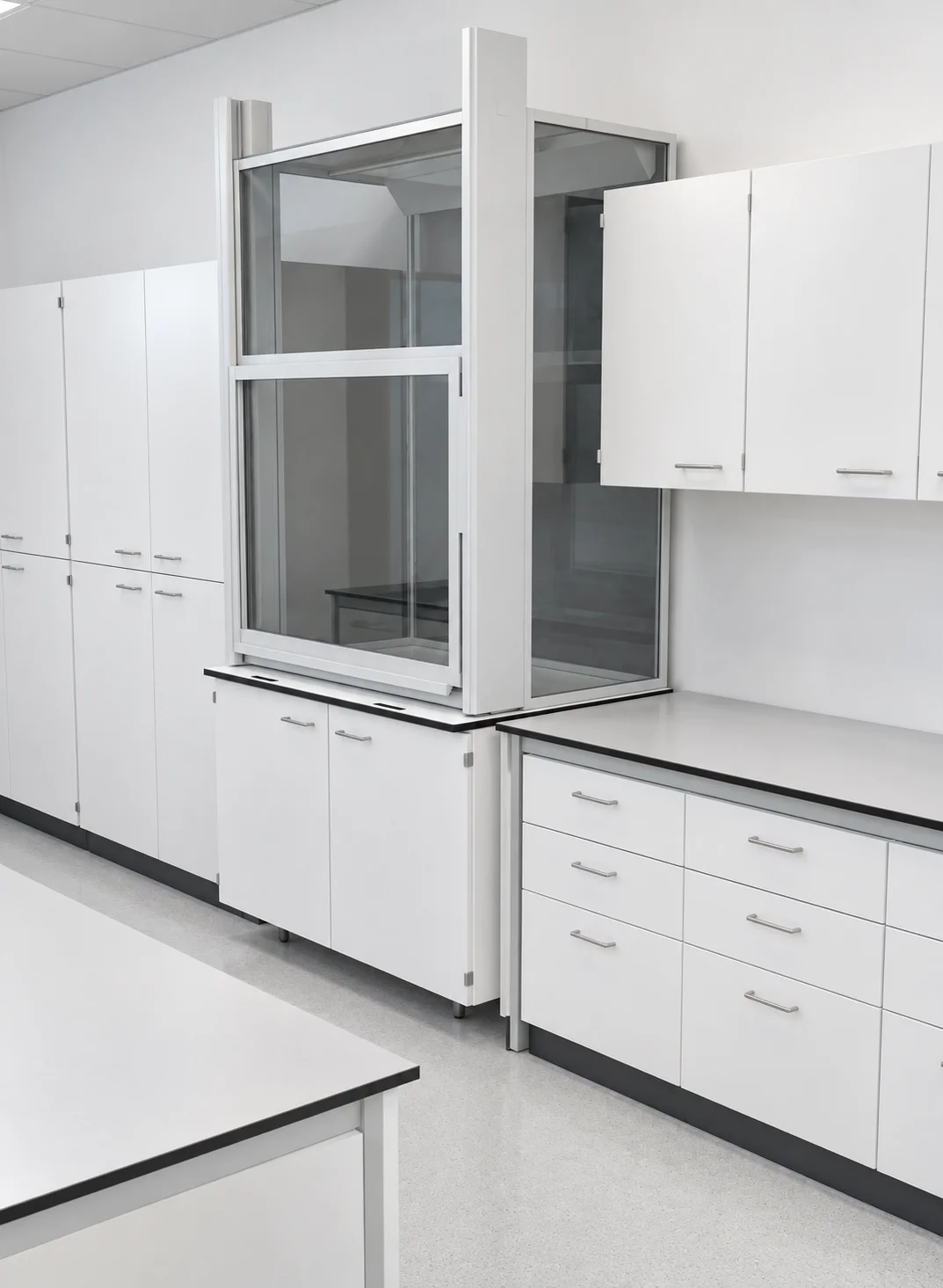
A carbon filter fume hood (ductless) traps harmful vapours in a filter and works without a connection to the ventilation system. An extraction fume hood is connected to the building's ventilation. The filter version is chosen where a duct is hard to run and the filter suits the reagents at the workstation. Both types are in the range of Renggli laboratory fume hoods.
How does a carbon filter fume hood differ from an extraction one?#
A carbon filter fume hood returns the cleaned air to the room, while an extraction fume hood sends the air with the vapours through a duct out of the building. Their task is the same: according to CIOP-PIB materials on chemical hazards in painting conservation workshops (opens in a new tab), fume hoods protect the worker from harmful vapours and gases released during work.
In a ductless fume hood, vapours go to a filter, usually a carbon one, which absorbs them. The guidance of the UK's University of Cambridge (opens in a new tab) stresses that operator protection depends on this absorption. In an extraction fume hood, the ventilation system carries the vapours away, so protection depends on the extraction capacity.
| Feature | Carbon filter fume hood | Extraction fume hood |
|---|---|---|
| Air path | through the filter and back into the room | through a duct to the outside of the building |
| Installation | no connection to ventilation | connection to central ventilation |
| What it traps | vapours and gases the filter was selected for; particles with a HEPA filter | vapours, gases and dusts from the chamber |
| What protection depends on | selection and condition of the filter | extraction capacity and airflow in the chamber's working opening |
| Operation | filter replacement based on saturation sensors | energy for extraction and for heating the supply air |
| Location | the workstation can be moved | fixed place next to the extraction duct |
Does a carbon filter fume hood need a ventilation connection?#
A carbon filter fume hood works without a connection to the ventilation system, so it can be placed where it is needed. It suits buildings where installing an extraction fume hood is impossible or not economically justified. Installation is shorter, and the workstation can be moved later.
An extraction fume hood needs a duct and a powerful extraction system. The airflow depends on the area of the chamber's working opening (the opening closed by a sliding sash) and on the air velocity in that opening. The installation is included in the ventilation design to keep the room's air balance. According to Renggli's questions and answers, connecting one fume hood to central ventilation is designed for 400 to 1,200 m³/h.
A room with a filter fume hood still needs general ventilation. CIOP-PIB materials on painting conservation workshops (opens in a new tab) recommend that local extraction be supported by general ventilation. Air exchange should keep concentrations below NDS (maximum admissible concentrations).
What substances can be used in a carbon filter fume hood?#
In a carbon filter fume hood, you work with substances the filter was selected for, at a known or expected concentration. Where, after a risk assessment, a filter fume hood is the only reasonably practical option, the guidance of the UK's University of Cambridge (opens in a new tab) requires the filter to be appropriate for the substance used at the known or anticipated concentration, and says to consult the filter manufacturer on its suitability.
LabAirTec green traps vapours of acids, solvents and bases with a single filter, and the unit works with most commonly used chemicals. For mixtures of chemicals, standard EN 17242 gives guidance on how to proceed, according to the standard's page in the Swedish SIS catalogue (opens in a new tab).
An extraction fume hood is chosen when vapours must be taken out of the building, because a filter fume hood returns the air to the room.
For areas at risk of explosion, Renggli offers explosion-proof (Ex) fume hoods. For work where vapours getting through a spent filter (filter breakthrough) would pose a direct danger to life or health, the University of Cambridge guidance (opens in a new tab) says a recirculating (filter) fume hood must not be used. In materials on painting conservation workshops (opens in a new tab), CIOP-PIB points to a fume hood in which vapours are carried to the outside.
How often is a carbon filter replaced, and how do you know it is spent?#
A carbon filter is replaced regularly, according to the readings of saturation sensors. The University of Cambridge guidance (opens in a new tab) describes how carbon becomes saturated over time, and the substance then passes into the room. That is why it recommends sensors that warn of an approaching end of filter life, and frequent filter replacement where there are none.
Because such a unit can fail without warning and failure cannot be predicted, the same guidance requires a filter fume hood in use to have a rigorous maintenance contract and be kept under constant review. LabAirTec green recognises the presence of a filter and tells a new filter from a spent one. It detects solvent and acid vapours, and an administrator checks the fume hood's status remotely, without switching it off.
Servicing a carbon filter fume hood includes checking and replacing carbon or HEPA filters. In an extraction fume hood, servicing includes calibrating the air velocity sensors in the chamber's working opening.
Which standards apply to extraction and ductless fume hoods?#
Extraction fume hoods are covered by the EN 14175 series, and ductless fume hoods since 2025 by EN 17242, which calls them recirculating fume hoods with filtration. Part PN-EN 14175-2:2006 sets out the safety and performance requirements for a fume hood, according to the standard's page in the PKN catalogue (opens in a new tab).
EN 17242:2025 applies to fume hoods that clean the air with a filter and return it to the room. According to the standard's page in the SIS catalogue (opens in a new tab), it sets design and construction requirements and procedures for type tests and on-site tests. For extraction fume hoods, the page refers to the EN 14175 series, and local regulations may limit where ductless fume hoods can be used.
The safety of furniture and fume hoods is checked against a standard, not a manufacturer's declaration, as stated on the page Our company. Our LabAirTec extraction fume hoods meet PN-EN 14175:2006 and undergo a tracer gas (SF₆) leak test before they are put into use.
What to check when ordering a fume hood?#
An order starts with a list of reagents and the conditions in the room, because they decide the choice of type. A checklist:
- List the reagents at the workstation with concentrations and quantities.
- Check whether an extraction duct can be run in the building and what the room's ventilation looks like.
- For a filter fume hood, ask for confirmation that the filter suits the list of reagents and concentrations.
- Require a filter monitoring system (presence, new or spent filter) and vapour detection.
- For an extraction fume hood, require compliance with PN-EN 14175:2006, a PZH approval or certificate and CE marking.
- Plan servicing and filter replacement together with the purchase.
How Renggli solves it#
We make both types of LabAirTec fume hoods. We build our LabAirTec extraction fume hoods at successive levels of airflow protection (the safety pyramid S1 to S4), from the standard version to one with an active air inlet. We fit the chamber to the equipment and the room. Our LabAirTec green ductless fume hood is started with an RFID card, and its software lets you manage a whole network of fume hoods.
For selection, a room plan, a list of workstations and information on utilities, including ventilation, are enough. In the laboratories of the BART investment near Warsaw, the fume hood stands in one layout with the furniture fittings we made.
Frequently asked questions#
Ductless fume hoods are also used in educational laboratories. The filter is selected for the reagents in the course programme, and general ventilation stays in the room.
A HEPA filter traps solid particles, but not the vapours and gases that a carbon filter absorbs. Where dusts and vapours arise at the same time, the ductless fume hood works with carbon and HEPA filters.
A ductless fume hood protects the operator when the filter suits the reagents and their concentrations, and the condition of the filter is monitored. LabAirTec green tells a new filter from a spent one and detects solvent and acid vapours.
Service checks the unit at a periodic inspection and replaces filters according to the readings of saturation sensors. For a unit without a sensor, the University of Cambridge guidance recommends frequent filter replacement.