School Fume Cupboards: What CLEAPSS G9 Requires
What CLEAPSS G9 asks of a school fume cupboard: 0.3 m/s face velocity, how many a school needs, ducted or filtration, and a test every 14 months.
 Renggli TeamEditorial team
Published: Updated Reading time: 9 min read
Contents
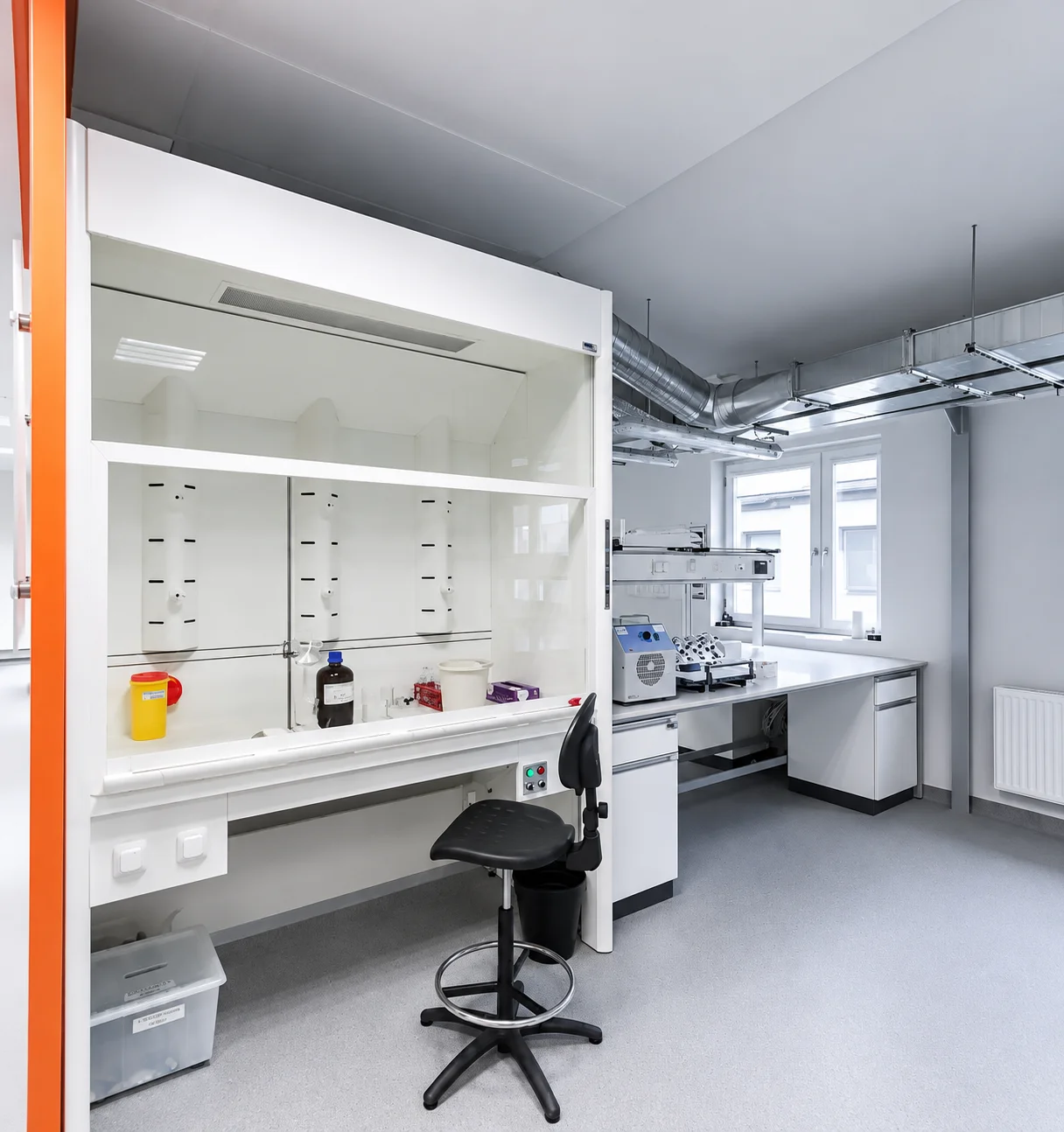
A school fume cupboard is a ventilated enclosure with a sliding sash in which teachers and technicians handle chemicals that give off hazardous fumes, gases or dust. In UK schools it is specified to CLEAPSS guide G9 Fume Cupboards in Schools, which replaced Building Bulletin 88 in 2014 and sets a face velocity of at least 0.3 m/s through the sash opening. Under COSHH, it then needs a thorough examination and test at least once every 14 months.
What is CLEAPSS G9?#
G9 is the CLEAPSS guide for anyone who uses, buys or designs fume cupboards for schools and colleges. It covers common problems, choosing and installing suitable cupboards, and maintaining and testing them. It replaced Building Bulletin 88 Fume Cupboards in Schools, published by the DfEE in 1998, and CLEAPSS sends a copy to non-members who ask by email.
The European standard for fume cupboards, BS EN 14175, leaves many parameters to be agreed between supplier and buyer. G9 narrows them down: its specification is in effect a subset of BS EN 14175 for school use, covering materials, dimensions, services, sash design, labelling and, above all, airflow. CLEAPSS and ASE model risk assessments assume that a school fume cupboard meets at least this specification, so a cupboard bought to a looser standard may not support the risk assessments the school relies on.
When does a school need a fume cupboard?#
A school needs a fume cupboard whenever the employer's risk assessment for an activity calls for one. Most schools use the model risk assessments from CLEAPSS, ASE or, in Scotland, SSERC, which compare the amount of a substance released in a school activity with the workplace exposure limits published by the HSE. As exposure limits are revised, activities once done on the open bench can move into the fume cupboard.
If the risk assessment requires a fume cupboard and the school has none, or the cupboard is not working to standard, the activity must not take place.
How many fume cupboards does a school need?#
The ASE summary of G9 gives these numbers:
| Where | Fume cupboards |
|---|---|
| Lab used for post-16 chemistry (A level or equivalent) | at least 2, and a third if classes are likely to exceed 15; one suitable for demonstrations |
| Labs where chemistry is taught to GCSE level | ideally one in every such lab |
| School that teaches chemistry in all its labs | fume cupboards in one third of the labs, with classes moving when the risk assessment requires |
| Lower secondary only | one in the prep room for technicians and one in a teaching lab, mainly for demonstrations |
The prep room needs its own cupboard because technicians dilute concentrated solutions, dispense volatile chemicals and deal with hazardous waste on a larger scale than a class. Using the fume cupboard in a teaching lab while a lesson is running would disrupt the lesson and put the technician at risk of being jostled.
What airflow does a school fume cupboard need?#
The air flowing in through the sash opening must reach at least 0.3 m/s and must not vary across the opening by more than G9 allows, because uneven flow creates eddies that carry fumes back out. As the sash is lowered, the velocity should not increase too much: university-style cupboards with high air flow can destabilise or even put out a Bunsen burner flame. A high flow rate is not the same as a safer school fume cupboard.
Noise matters too. A loud cupboard makes teaching difficult and tempts staff to switch it off too early, and G9 has a stricter noise requirement than Building Bulletin 88 had.
Ducted or filtration fume cupboard in a school?#
A ducted fume cupboard sends the air outside the building; a recirculatory filtration fume cupboard passes it through a pre-filter and filter and returns it to the room. The ASE summary of G9 is clear that a ducted cupboard is safer, while a filtration cupboard can be the right answer in temporary labs or listed buildings where ductwork is impractical.
| Ducted | Recirculatory filtration | |
|---|---|---|
| Where the air goes | outside, through a duct with the fan at or near roof level | back into the lab, through a pre-filter and filter |
| Installation cost | higher: ducting can cost 2 to 4 times the price of the cupboard | lower: no ductwork |
| Not for | no filter limits; the risk assessment decides | hydrogen, methane, carbon monoxide, mercury vapour |
| Running costs | extraction energy, which is small for short school use | replacement filters and pre-filters, and filter testing |
| When it fails | an airflow indicator, if fitted, shows the drop in extraction | not fail-safe: a saturated filter lets fumes through |
Filters for schools have to be specially treated, because the main challenge in a school lab is acidic gases such as hydrogen chloride, bromine and sulfur dioxide, plus ammonia, while ordinary carbon filters are best at organic solvents. Once a sealed filter is opened, manufacturers usually give it a shelf life of about 5 years even if it has absorbed nothing. Recirculatory filtration fume cabinets also have their own European standard, BS EN 17242:2025.
Should a school fume cupboard be mobile?#
Mobile fume cupboards are often bought to save money, but the ASE summary of G9 notes they are rarely moved: uncoupling services, clearing stools and waiting for empty corridors takes too much technician time. A semi-mobile cupboard that can be pulled about 1 m from the wall is a better compromise for demonstrations, because 30 or so pupils can gather round with a clear view. Flexible connections for gas and electricity bring their own checks.
How often must school fume cupboards be tested?#
At least once every 14 months. COSHH regulation 9 requires a thorough examination and test of local exhaust ventilation at that interval, and schools find an annual cycle easier to remember. The test compares current performance with the commissioning report made when the cupboard was installed, so make sure someone from the science department is present at commissioning and keeps the report, the user manual and the log book. Who may carry out the examination and what the report should record is set out in our guide to fume cupboard testing.
The most important measurement is air velocity at the sash, taken with an accurate meter. For filtration cupboards, filter saturation is tested too, unless the filters are replaced on a fixed schedule. Between examinations, a simple swing-vane anemometer shows whether air is flowing in the right direction.
What to check before each use#
The ASE checklist, built on G9, asks the user to:
- look for damage to the ducting, services, sash and cupboard, and for evidence of a test within the last 14 months (and, for a filtration cupboard, a filter that is not past its use-by date);
- check that the trap of any sink in the cupboard holds water;
- switch on the extraction and confirm satisfactory airflow on the indicator or with an anemometer;
- keep the sash as low as possible and never above the maximum working height stop;
- leave the extraction running until no more fumes are being produced;
- leave the fume cupboard clean and ready for the next user.
What we supply for school labs#
We offer LabAirTec ducted fume cupboards and the LabAirTec green ductless fume cupboard with Erlab molecular filtration. Ducted units are supplied with extract ducts, ready for connection; the extract fan is not part of the delivery and is planned with the building's ventilation, which suits the G9 advice to place the fan at or near roof level. Renggli AG issued a manufacturer's declaration of conformity for its Euro II and LabAirTec fume cupboards to EN 14175 parts 1 to 6 on 6 February 2015.
We quote the fume cupboard together with the surrounding school lab furniture, because benches, sinks and services decide where the cupboard can stand. See the laboratory fume hood range, the ducted fume hoods and the ductless fume hood, or our school science labs page. A side-by-side comparison of fume cupboard types is in our guide fume hood types compared.
Frequently asked questions#
A school needs one whenever the risk assessment for an activity requires it, and the UK science curricula at secondary level cannot be delivered without access to at least one. If the risk assessment calls for a fume cupboard and none is available or working, the activity must not take place.
At least 0.3 m/s through the sash opening, spread evenly across it. The velocity should not rise sharply as the sash comes down, because a strong draught can put out a Bunsen burner flame.
At least once every 14 months, under regulation 9 of COSHH. The thorough examination and test compares current performance with the commissioning report, and the air velocity at the sash is the key measurement.
No. CLEAPSS guide G9 Fume Cupboards in Schools replaced Building Bulletin 88 in 2014. The 2025 revision of G9 updated references and links without changing performance or design requirements.
Yes, with limits. A filtration fume cupboard needs filters designed for the acidic gases used in schools, regular filter testing or replacement, and it must not be used for hydrogen, methane, carbon monoxide or mercury vapour. A ducted cupboard is the safer choice where a duct can be installed.
Sources#
- G9 Fume Cupboards in Schools (opens in a new tab), CLEAPSS, 2014, revised 2025.
- Topics in Safety, Topic 7: Fume cupboards (opens in a new tab), Association for Science Education, July 2015.
- The Control of Substances Hazardous to Health Regulations 2002, regulation 9 (opens in a new tab), legislation.gov.uk.
- BS EN 17242:2025 Recirculatory filtration fume cabinets (opens in a new tab), BSI.