Laboratory extractor and fume hood - what is the difference and what to choose?
A laboratory extractor is an arm, hood or fume hood. An arm captures fumes only near its inlet; a fume hood encloses the source, so it suits toxic substances.
 Renggli TeamEditorial team
Published: Updated Reading time: 9 min read
Contents
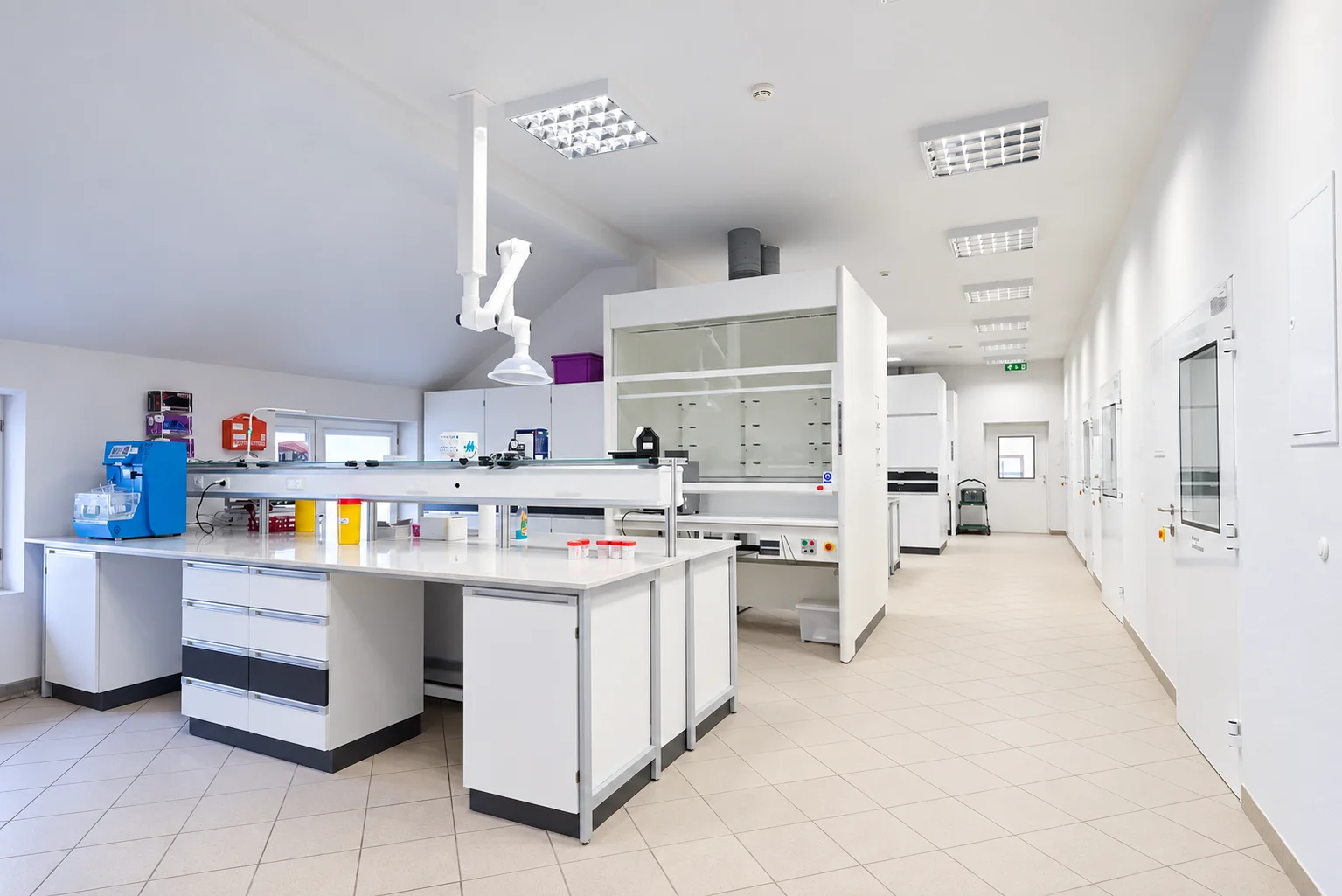
A laboratory extractor is a device that draws contaminated air away from the workstation before it reaches the operator: an extraction arm, a capturing hood, a canopy hood or a fume hood. A fume hood gives the fullest protection, because its chamber with a sliding sash encloses the source of the fumes. For toxic, volatile and corrosive substances the choice is a laboratory fume hood, while an arm or canopy hood suits heat, steam and odours.
What is the difference between a laboratory extractor and a fume hood?#
Laboratory extractor is the name for a whole group of devices, and a fume hood is one of them: an enclosed chamber where you work behind a glass sash. Extraction arms, capturing hoods and canopy hoods collect air at one point above or beside the workstation, but they do not enclose the source. What a fume hood itself is and how it works is explained in our post on what a fume hood is.
In its HSG258 guide to local exhaust ventilation (opens in a new tab), the UK Health and Safety Executive (HSE) divides extraction into enclosures, receiving hoods and capturing hoods, and classes the fume hood as a partial enclosure. According to the same guide, an enclosure shields the source from draughts, and its walls allow effective protection with a lower airflow than a capturing hood needs. A fume hood is also loosely called a chemical extractor, and in English it is known as either a fume hood or a fume cupboard.
| Criterion | Extraction arm, capturing hood | Canopy hood over the workstation | Fume hood |
|---|---|---|---|
| How it works | draws air from a small zone in front of the inlet | collects warm air and steam rising from the source | encloses the source in a chamber with a sliding sash |
| Who it protects | the zone right at the inlet | the room, from heat and steam | the operator, from fumes, gases and dusts |
| Typical tasks | soldering, spot work, process odours | hot processes, water vapour | toxic substances, volatile solvents, acids and alkalis |
| What weakens it | distance from source to inlet, draughts | draughts, people moving around | sash opened too high, no airflow monitoring |
| Connection | exhaust system or filter unit | exhaust system | exhaust duct, or a filter in the ductless version |
When is an extraction arm or canopy hood enough?#
An extraction arm or canopy hood is enough where the process produces heat, water vapour or a non-toxic odour and the operator does not need to be separated from the source. They work well for soldering, spot work at equipment and removing process odours.
Extractors like these have a short reach. According to the HSE (opens in a new tab), a capturing hood usually works only when the source is closer than two diameters to its inlet. A small change in working position therefore decides whether the fumes go into the hood or into the breathing zone.
Information material from CIOP-PIB (opens in a new tab) points out that even effective local extraction does not capture everything, and some of the contaminants escape into the room. If the process involves toxic gases, volatile solvents or corrosive substances, an arm cannot replace a fume hood.
Do health and safety regulations require extraction for work with chemicals?#
The regulations require risk to be reduced in a set order, and ventilation at source comes before personal protective equipment. In § 8, the Minister of Health regulation on safety at work with chemical agents (opens in a new tab) first lists eliminating the agent and limiting its release. Next come collective protection measures at the source of the hazard, “such as, for example, adequate ventilation”, and only last personal protective equipment.
The same regulation (opens in a new tab) links the choice of measures to the results of the occupational risk assessment. The type of extractor is therefore chosen after listing the substances, their quantities and the tasks at each workstation: that list decides whether an arm is enough or a fume hood is needed.
Fume hood vs laminar flow cabinet: which protects the operator?#
A fume hood protects the person and a laminar flow cabinet protects the sample, so one cannot replace the other. A fume hood draws air from the room and removes it together with the fumes. A laminar flow cabinet supplies HEPA-filtered air to the work area to keep the test material free of contamination, so it does not draw chemical fumes away from the operator.
For biological agents, where the product, the operator and the environment all need protection, a biological safety cabinet is used. A lab that combines chemistry and biology usually needs both devices at separate workstations.
Ducted or ductless fume hood: what about the lab's ventilation?#
The choice depends on whether the room has an exhaust duct and which substances go into the chamber. A ducted fume hood is connected to the central ventilation, which is designed for 400 to 1,200 m³/h per workstation, and discharges the air outside the building. How much air a particular model needs follows from the sash opening area and the face velocity; the method is shown in our post on how to calculate fume hood airflow.
Air extracted from the lab has to be replaced with supply air. The HSE (opens in a new tab) warns that without planned make-up air, strong draughts develop and the extraction does not work as designed. That is why a fume hood is designed together with the room's ventilation.
Airflow control decides the running costs. A constant air volume (CAV) system extracts the same amount of air whether the sash is open or closed. A VAV (variable air volume) system keeps the face velocity at the sash constant, and when the sash is lowered it reduces the air demand and the cost of heating the supply air.
The ductless LabAirTec “green” fume hood cleans the air through a carbon or HEPA filter and returns it to the room, so it needs no ducts. It works well for repeatable processes with a known, limited set of substances. According to the HSE (opens in a new tab), a recirculating fume hood for dusts, mists and fumes should have a HEPA filter and continuous monitoring; the LabAirTec “green” recognises a new and a spent filter and detects solvent and acid vapours.
How do you check that a laboratory extractor protects the operator?#
Measurements confirm how well an extractor works, and for fume hoods the methods are set out in EN 14175-2, EN 14175-3 and EN 14175-4. CIOP-PIB (opens in a new tab) uses them to assess extractors in a type test in the laboratory and in a test of a specific extractor at the workplace. The measurements include air velocity in front of the extractor and in the room, the airflow in the exhaust duct and containment, and the airflow is shown by visualisation. The same institute also tests local exhaust ventilation systems to the EN 1093 series, so measurements can be ordered for extractors other than fume hoods as well.
A buyer who writes EN 14175 into the order specification can ask for the test report. In use, Renggli recommends a technical inspection at least once a year and a new airflow measurement after every change to the room's ventilation or after the fume hood is moved.
What to look for when ordering a fume hood#
When ordering, what counts are the substances, the room dimensions, the services and the airflow control method. We make LabAirTec fume hoods in free-standing, bench-top, walk-in and double-chamber versions. Free-standing versions are usually 1,200 to 1,800 mm wide. The walk-in version, for tall equipment standing on the floor, ranges from 900 to 3,000 mm.
The ducted version has a four-stage S1 to S4 safety system. It starts with the Bypass system and an eye-level panel, and the next stages add air volume control based on sash position, automatic sash closing and an active air inlet. Before handover, the fume hood passes a leak test with SF6 tracer gas.
We match the chamber material to the reagents: large-format ceramics for concentrated acids, polypropylene for hydrofluoric acid, stainless steel where disinfection matters. We offer epoxy resin for concentrated alkalis and inorganic acids, and HPL laminate for standard analyses. For explosion hazard zones we offer fume hoods in an Ex version.
We bring the services into the chamber and the valves out to an external panel, so the operator can shut them off without reaching inside; gas and water are supplied through ready-made fume hood tap and valve sets. We quote the fume hood together with the surrounding laboratory furniture, because the furniture determines the connections and the air balance of the room.
Frequently asked questions#
A fume hood is an enclosed laboratory workstation with forced airflow that draws away fumes, gases and dusts before they reach the operator. The air goes through a duct to the outside of the building or through a filter back into the room. The requirements for fume hoods are set out in EN 14175.
Chemical extractor is a loose name for a fume hood, that is, an extractor with an enclosed chamber for work with chemical substances. The same term is sometimes used for arms and hoods above the workstation, so an enquiry should state whether it concerns a chamber or point extraction.
The price of a fume hood is set for a specific configuration: it depends on the type and width, the chamber material, the airflow control and any special version, such as Ex. Service connections and the room's ventilation add to the cost, so a fume hood is quoted together with the lab's furniture and installations.
The Polish word dygestorium is a fume hood or fume cupboard in English, and catalogues also use laboratory fume hood and chemical fume hood. Local extraction, such as an extraction arm, is called local exhaust ventilation (LEV) in British health and safety guidance.
A ducted fume hood is connected to the building's central ventilation, which is designed for 400 to 1,200 m³/h per workstation. The ductless version needs no duct, because it cleans the air through a carbon or HEPA filter and returns it to the room.