What criteria should professional laboratory furniture meet?
Professional laboratory furniture is the foundation for safe and effective work. Their choice cannot be accidental, as it directly affects the hygiene of work, the durability of equipment and compliance with health and safety regulations.
 Renggli TeamEditorial team
Published: Updated Reading time: 6 min read
Contents
What criteria should professional laboratory furniture meet?
Professional laboratory furniture is the foundation for safe and effective work. Their choice cannot be accidental, as it directly affects the hygiene of work, the durability of equipment and compliance with health and safety regulations. The key criteria are chemical resistance, mechanical durability and ease of disinfection.
Laboratory countertops should be smooth, non-porous, and resistant to chemical absorption, which allows you to effectively maintain sterility. Structures based on steel frames, most often madeof powder-coated steel, are standard, which ensures high corrosion resistance and stability of the structure even under heavy loads.
In practice, it is worth striking a balance between price and quality. A low price often means compromises in terms of stability, fit of components and safety of use, which is unacceptable in the laboratory.
How to match the worktop material to the type of analysis performed?#
The choice of a laboratory table should result directly from the specifics of the research work. That is why laboratory design should begin with a list of the planned procedures, equipment and media, and only then move on to the layout of the furniture.
- Epoxy resin - very high resistance to acids, alkalis and solvents, no welds, good mechanical resistance; a popular choice in chemical laboratories.
- Technical ceramics (solid ceramics) - the highest chemical and thermal resistance, ideal for aggressive processes and high temperatures.
- Stainless steel / acid-resistant steel - excellent hygiene, corrosion resistance, easy to disinfect; preferred in medical and microbiological laboratories.
- HPL laminate - a cost-effective solution for educational laboratories and laboratories with low chemical load.
- Alternatives: ceramic sinter, quartz-granite conglomerate, phenolic resin.
| Material | Chemical resistance | Thermal resistance | Mechanical resistance | Cost |
|---|---|---|---|---|
| Epoxy resin | Very high | High | High | Medium |
| Technical ceramics | Highest | Highest | Very high | High |
| Stainless steel | High | Average | Very high | Medium |
| HPL Laminate | Average | Low | Average | Low |
With acid-resistant steel, load capacity also matters. A worktop made of this material carries up to 150 kg, and up to 200 kg in fume hoods. Acid-resistant steel is also resistant to pitting corrosion. Whatever the material, the worktop must withstand intensive cleaning cycles with aggressive biocidal preparations, so before you buy, ask the manufacturer which agents may be used to clean the surface in question.
Laminated laboratory furniture (HPL laminate) and plastic components (PP, PVC) protect against moisture and weaker acids. They work well in a laboratory where no strong acids or solvents are used. For such substances, epoxy resin or technical ceramics is the better choice.
Which lab benches to choose to optimize your workspace?#
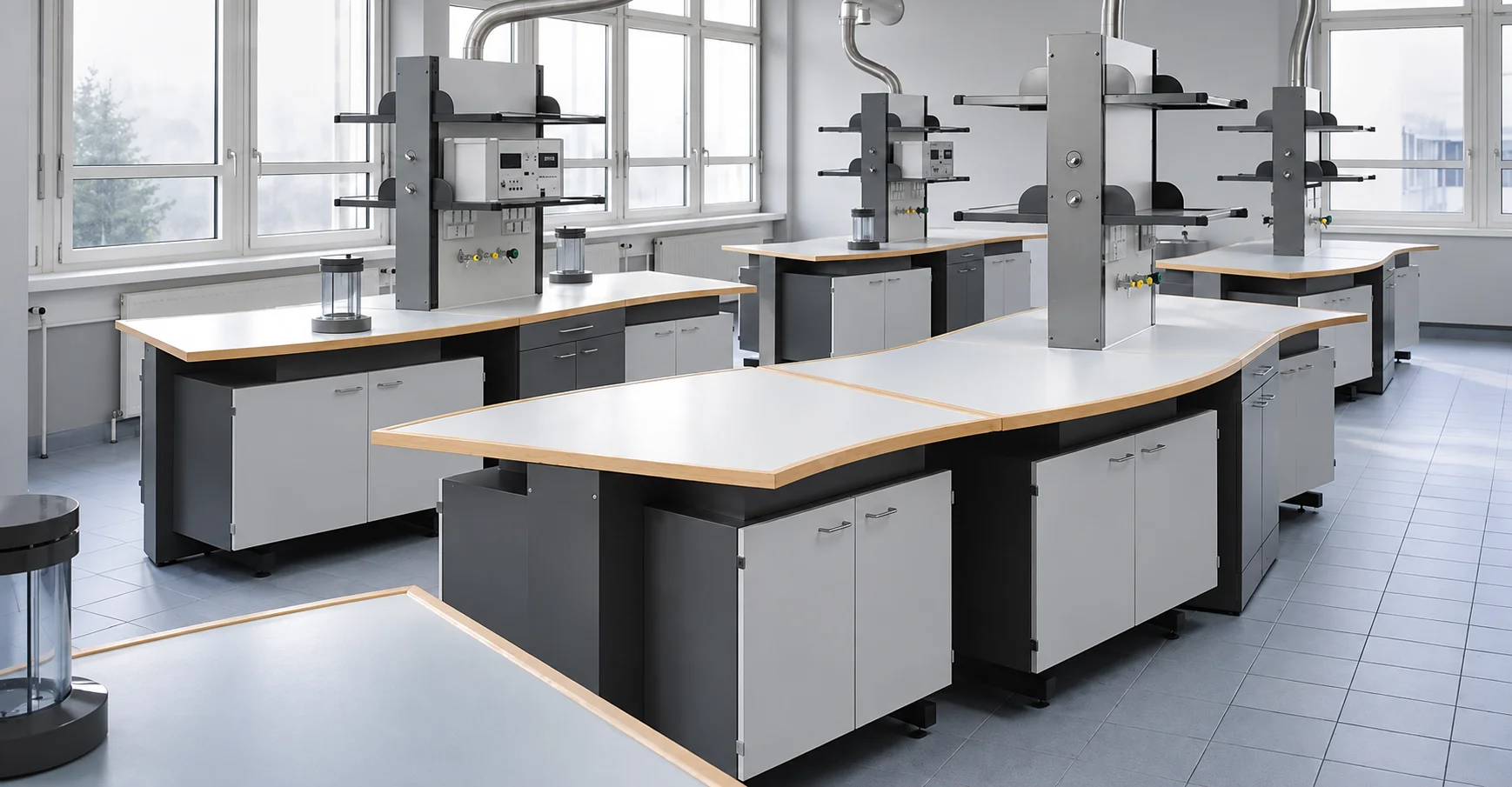
Laboratory tables are the heart of every laboratory. Their arrangement affects ergonomics and work organization.
- Island tables - access from all sides, ideal for teamwork and research labs.
- Wall-mounted tables - space-saving, easy integration into installations.
- Anti-vibration (weighing) tables - necessary for precise measurements and work with analytical balances.
- Mobile solutions: laboratory trolleys, mobile tables.
Each table should be equipped with laboratory media:
- water,
- gas,
- electrical sockets,
- sewage disposal systems, which increases the functionality and safety of the site.
What to look for when choosing fume hoods and ventilation systems?#
Fume hoods are key mass protection devices in the laboratory. They ensure safe work with fumes, gases and volatile substances. Their interior must be made of chemically resistant materials, such as technical ceramics or polypropylene.
Depending on the application, the following are used:
- chemical extracts,
- laminar flow chambers,
- glove chambers.
Effective mechanical ventilation, airflow monitoring and appropriate tempered glass in the work covers are essential.
A fume hood is meant to isolate the operator from toxic substances, including volatile organic compounds (VOCs). When choosing one, check that the model complies with EN 14175 and has airflow sensors that let you monitor the airflow continuously.
Check the offer: laboratory fume hoods
In which safety cabinets should acids, alkalis and flammable materials be stored?#
Safe storage of chemicals requires the right solutions:
- Reagent cabinets - ventilated, for everyday use.
- Safety cabinets (fireproof) - designed for flammable substances.
A key requirement is compliance with the EN 14470-1 standard, which defines fire resistance classes:
- type 30 - 30 minutes,
- type 90 - 90 minutes.
For strong acids, corrosion-resistant polypropylene cabinets are recommended. Safety locks, spill trays and dedicated cabinets for gas cylinders are also standard.
What safety standards and approvals are required for laboratory equipment?#
Certified equipment is a guarantee of legal safety and health of employees. The most important standards are:
- PN-EN 13150 - laboratory tables,
- EN 14175 - fume hoods,
- EN 14470-1 - fireproof cabinets,
- PN-EN 14727 - storage furniture.
In addition, the following are required:
- PZH Certificate / PZH Certificate,
- compliance with health and safety regulations,
- hygiene class E-1.
Meeting these requirements is in line with the principles of Good Laboratory Practice (GLP).
For laboratory and medical furniture, alongside EN 14727, it is also checked whether the manufacturer holds ISO 9001 certification (quality management system). For every standard the manufacturer declares, ask for a certificate or a test report.
Check the offer: medical furniture.
How do ergonomics and modularity of furniture affect work efficiency?#
Modern laboratories focus on modularity, which allows for easy reconfiguration of the space along with the change of research processes. Modular furniture allows you to expand your workstations without costly renovations.
Ergonomics includes:
- height-adjustable chairs and laboratory stools,
- easy-to-clean surfaces,
- antistatic (ESD) solutions in technology laboratories.
Well-designed storage (undercounter cabinets, hanging cabinets, glass cabinets) improves workflow and reduces staff fatigue.
A separate decision is how the cabinets are fitted under the worktop:
- plinth cabinets integrated with the worktop in a fixed run suit laboratories with strictly defined technological processes,
- cabinets suspended from the table structure leave the floor clear, which makes it easier to keep clean.
Extensions, shelves and media connections are selected to match the analyses carried out at a given workstation. A station for testing medical equipment looks different from a biomedical engineering laboratory, and different again from a station for analyzing the purity of aquatic environments.
See also: ventilation in the laboratory.
How to calculate the Total Cost of Ownership (TCO) of laboratory furniture?#
At the budget planning stage, cheaper, standard furniture is tempting because of its lower purchase price. However, the Total Cost of Ownership (TCO) also covers servicing and the replacement of components that have worn out prematurely.
Furniture built on solid steel structures, with surfaces that withstand daily, intensive use, needs servicing less often and does not undergo premature degradation. That is why its TCO is lower in the long run, despite the higher upfront price. When comparing offers, ask the manufacturer about the frame and worktop materials and the standards the furniture complies with.
Investor's checklist before buying laboratory furniture
- What chemicals will be used?
- Is sterility or high temperature resistance required?
- What standards and certificates must furniture meet?
- Will the laboratory be expanded in the future?
- What media must be brought to the positions?