Tender evaluation criteria: price carries most weight
In Polish laboratory furniture tenders since 2021, price usually weighed exactly 60% in tender evaluation criteria and was the sole criterion in one in five.
 Renggli TeamEditorial team
Published: Updated Reading time: 10 min read
Contents
Article 246 of the Polish Public Procurement Law (opens in a new tab) allows price at most 60% of the weight in tender evaluation criteria. The exception is a contracting authority that sets quality requirements in the description of the subject matter of the contract: price may then weigh more, or even be the only criterion. The rule applies to the public contracting authorities listed in Article 4 points 1 and 2 of the Act, including public finance sector units. In tenders for laboratory furniture, price almost always weighs at least 60%: it weighed less in only 10 tenders out of more than a thousand. Among the other criteria, contracting authorities most often choose the warranty and the completion time.
A single procurement procedure is often divided into lots, and each lot has its own criteria and its own bids. That is why this article counts each lot as a separate tender.
- tenders with known weights for all criteria
- 1,134
- with price weighing exactly 60%
- 63%
- with price alone, no other criteria
- 21%
- bids in a typical tender
- 2
How much weight does price carry in tender evaluation criteria?#
Most often exactly 60%, the most the law allows without a description of quality requirements. Price carried this weight in almost two thirds of the tenders (63%). The second most common choice is price alone, with no other criterion: one tender in five was evaluated this way (21%).
In most tenders price carries exactly 60% of the weight
Share of laboratory furniture tenders (contract lots) by the weight of price in the tender evaluation criteria, n = 1,134 lots with known weights of all criteria, notices from January 2021 to September 2026, 95% confidence intervals
Show data
| Category | Value | 95% interval | n |
|---|---|---|---|
| Price alone (100%) | 21% | 19 to 24% | 1,134 |
| 80% to under 100% | 13% | 11 to 15% | 1,134 |
| Above 60% and under 80% | 2.4% | 1.6 to 3.4% | 1,134 |
| Exactly 60% | 63% | 60 to 66% | 1,134 |
| Under 60% | 0.9% | 0.5 to 1.6% | 1,134 |
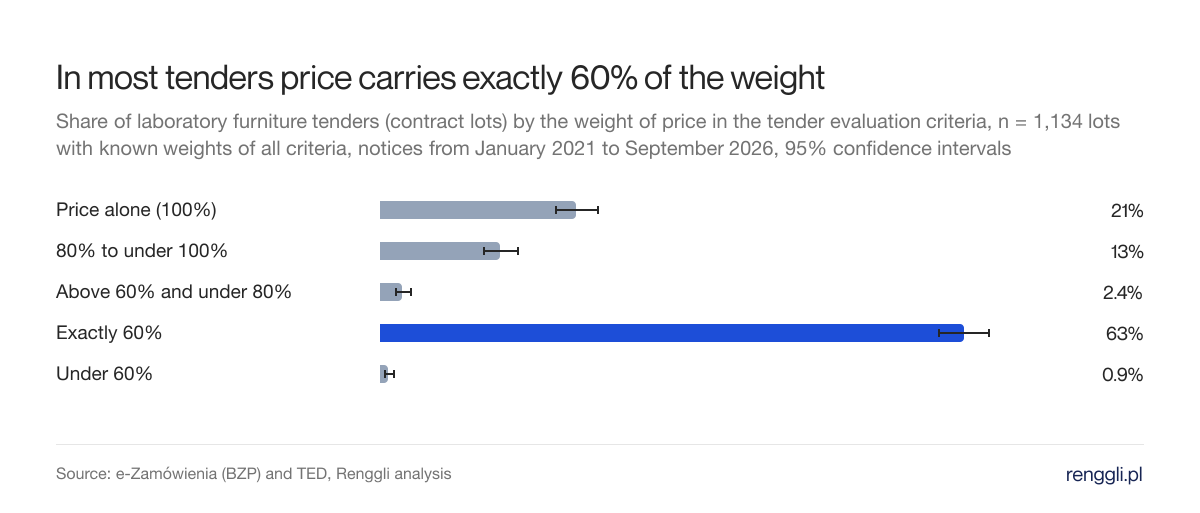
The same chart as an image. Reuse it with attribution (CC BY 4.0).
When price weighed more than 60%, it was most often the only criterion. The first and the last full year look similar: in 2021, 16% of tenders were evaluated on price alone, in 2025, 19%. With this number of tenders, such a gap could arise by chance, so it is no evidence of a change. The year 2026 is not compared here because it is still under way.
Which non-price criteria do contracting authorities choose?#
Besides price, contracting authorities most often awarded points for the warranty: they did so in more than half of the laboratory furniture tenders (57%). Completion time, meaning the time within which the bidder undertakes to perform the contract, was a criterion in 28% of tenders. Quality and technical parameters were rarely scored: in 4.4% of tenders.
Besides price, warranty and completion time count most often
Share of laboratory furniture tenders (contract lots) with at least one criterion in a given category, n = 1,172 lots with criteria, notices from January 2021 to September 2026, 95% confidence intervals; a lot can have several categories
Show data
| Category | Value | 95% interval | n |
|---|---|---|---|
| Warranty | 57% | 54 to 60% | 1,172 |
| Completion time | 28% | 26 to 31% | 1,172 |
| Other criteria | 11% | 9.6 to 13% | 1,172 |
| Quality and technical parameters | 4.4% | 3.4 to 5.8% | 1,172 |
| Service | 1.4% | 0.8 to 2.2% | 1,172 |
| Life-cycle cost | 1.2% | 0.7 to 2% | 1,172 |
| Social aspects | 1.1% | 0.6 to 1.9% | 1,172 |
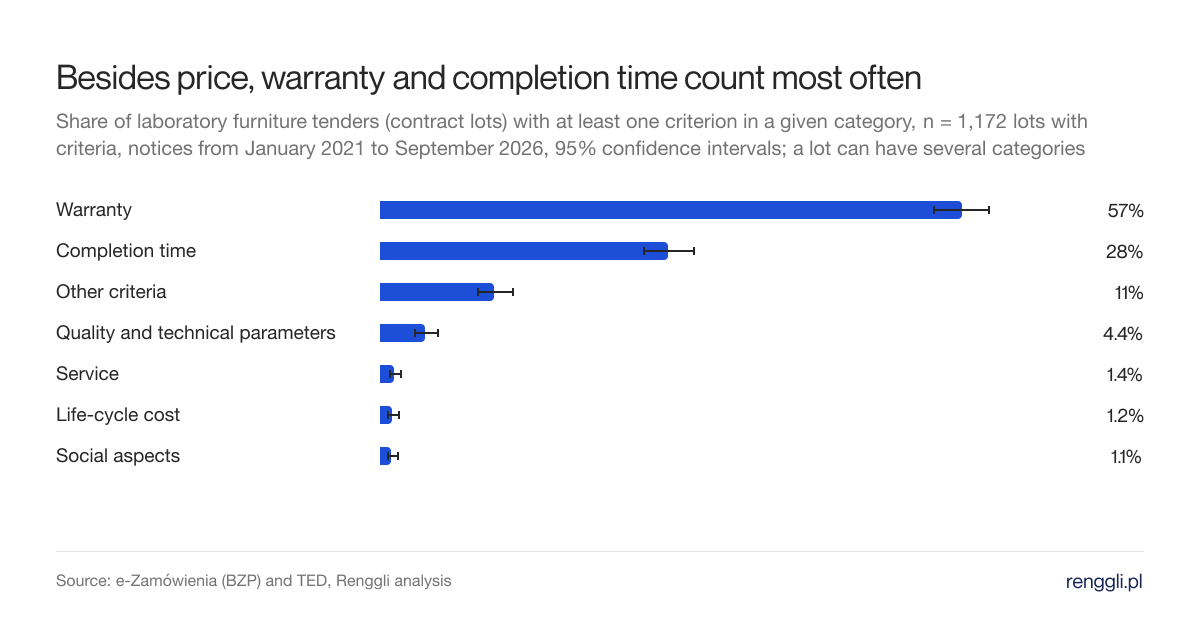
The same chart as an image. Reuse it with attribution (CC BY 4.0).
Warranty and completion time are easy to compare, because the bidder enters a number of months or days in the bid. For a quality criterion, the contracting authority has to describe in advance what earns points and how the evaluation committee will check it. The data do not show whether this is why such a criterion is rare.
Which contracting authorities evaluate bids on price alone?#
Research institutes had the highest share of price alone: they evaluated two in five of their tenders this way (41%). Universities announced the most tenders and evaluated one in five of them on price alone (20%). Schools (7.8%) and public administration and local government (8.5%) chose price alone least often.
Research institutes evaluated two in five of their tenders on price alone
Share of laboratory furniture tenders (contract lots) with price as the only criterion by type of contracting authority, n = 1,134 lots with known weights of all criteria, notices from January 2021 to September 2026, 95% confidence intervals; types with fewer than 30 lots grouped as Other
Show data
| Category | Value | 95% interval | n |
|---|---|---|---|
| Research institutes | 41.5% | 33.8 to 49.6% | 147 |
| State inspectorates and laboratories | 25.9% | 16.3 to 38.4% | 58 |
| Other (incl. uniformed services and companies) | 24.5% | 14.9 to 37.6% | 53 |
| Universities | 19.6% | 16.5 to 23.2% | 545 |
| Healthcare | 17.3% | 12.4 to 23.7% | 173 |
| Public administration and local government | 8.5% | 4.4 to 15.9% | 94 |
| Schools | 7.8% | 3.4 to 17.0% | 64 |
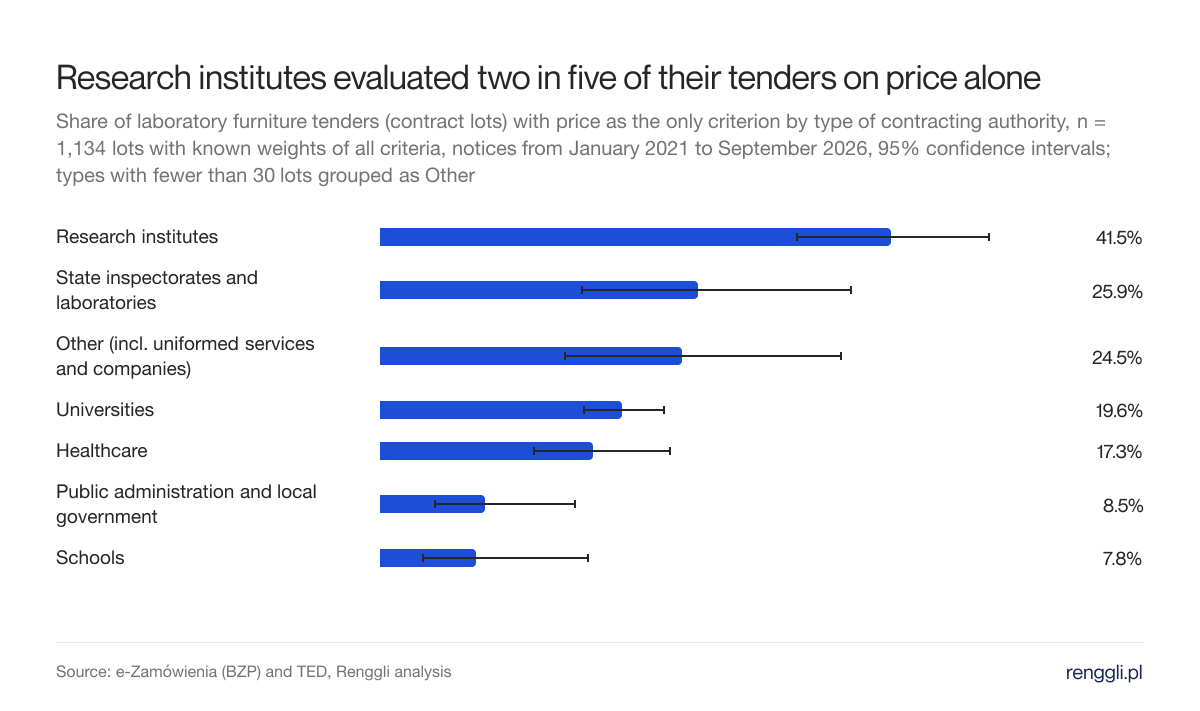
The same chart as an image. Reuse it with attribution (CC BY 4.0).
The four smallest groups (schools, state inspectorates and laboratories, public administration and local government, and Other) had fewer than a hundred tenders each, so their results are less certain. The data also do not show why research institutes chose price alone so often. The notices do not reveal whether they described the quality requirements that allow it, or whether the 60% limit applies to them at all.
Does price alone attract more bids?#
The data do not confirm it. If price alone attracted bidders, such tenders would end with a single bid less often. A single bid came in for 27% of tenders evaluated on price alone and for 31% of tenders where price was one of several criteria. With this number of tenders, such a gap could arise by chance, so it shows no link.
Bids are scarce in general: half of the laboratory furniture tenders received at most 2 bids. The analysis does not account for the scope of contracts, the time allowed for bids or the region, so it does not show what the number of bids depends on.
What this means for tender specifications (SWZ)#
When writing tender specifications (SWZ, the Polish equivalent of tender documents) for laboratory furniture, three things are worth checking.
Price above 60% only with quality requirements in the description of the subject matter of the contract
An authority covered by Article 246 may give price a weight above 60%, or evaluate bids on price alone, if it describes quality requirements. The description of the subject matter of the contract must set these requirements at least for the main elements of the contract (Article 246(2) of the Public Procurement Law (opens in a new tab)). For laboratory furniture, this can be the material of laboratory countertops, the construction of cabinets or the requirements for fume hoods.
A warranty criterion that separates the bids
If the maximum points go to a warranty period that every bidder offers anyway, all bidders get the same points. Price then decides the choice regardless.
A quality criterion the committee can check
A quality criterion works when the bidder enters a specific feature in the bid, such as a material or a construction method, and the committee scores it on a scale described in advance. The features worth describing are listed in the article on the features laboratory furniture should have.
Method and data#
The unit of the data is the contract lot, because the contracting authority gives the criteria and the number of bids for each lot separately. A procedure can be divided into lots, for example by laboratory or by type of furniture.
Frequently asked questions#
It can. A Polish public contracting authority covered by Article 246 of the Public Procurement Law (opens in a new tab) must then set quality requirements in the description of the subject matter of the contract. In laboratory furniture tenders since 2021, one tender in five was evaluated on price alone (21%).
Most often the warranty, which earned points in more than half of the tenders (57%), and the completion time (28%). Quality and technical parameters were scored in only 4.4% of tenders.
Few: half of the tenders since 2021 received at most two bids, and almost one in three received just one (31%).
60%, the most the law allows without a description of quality requirements. Price carried this weight in 63% of laboratory furniture tenders since 2021.