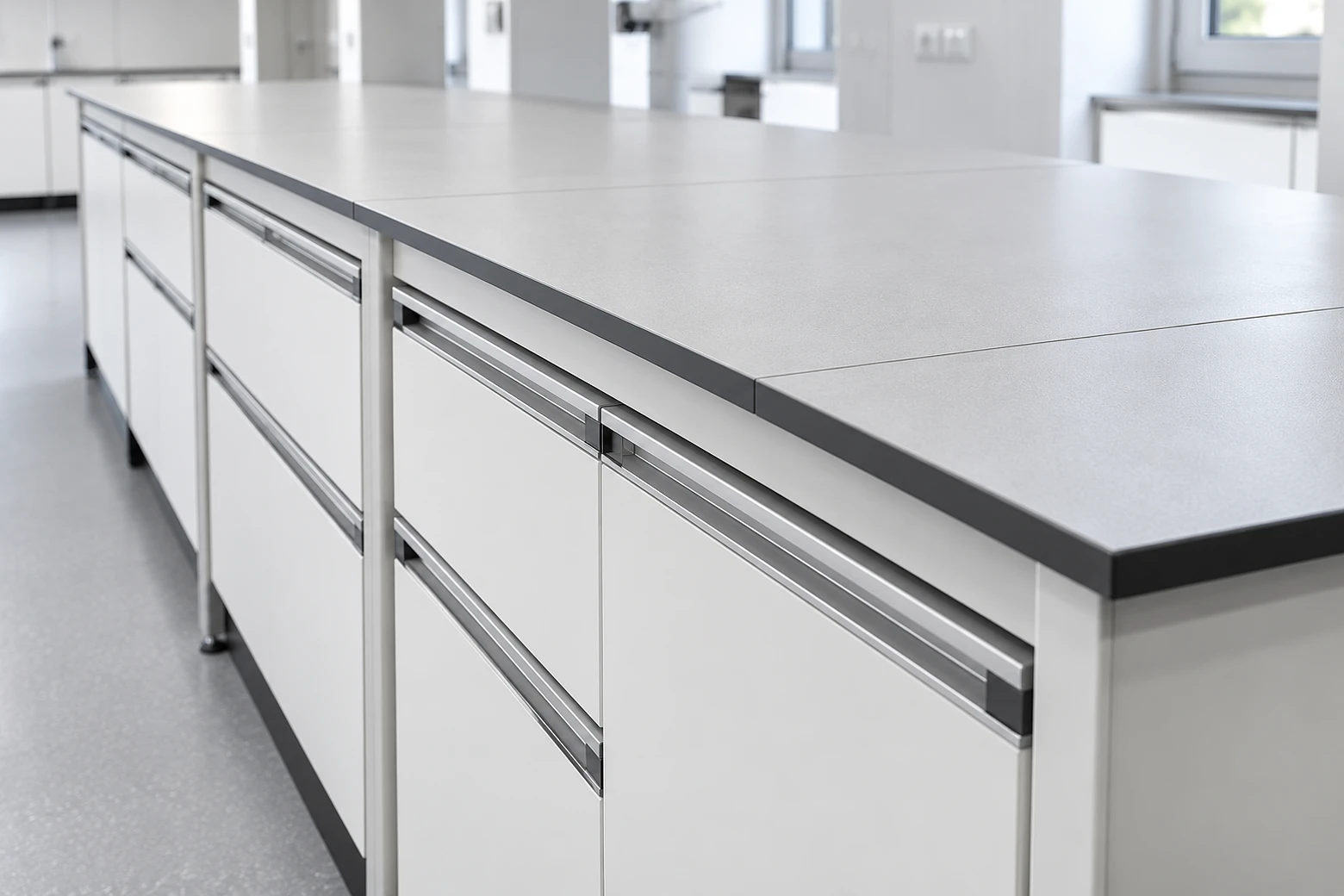
Laboratory furniture prices and quotations
The price of laboratory furniture depends on five things: the furniture system, the worktop material, the number of laboratory fume hoods and utility outlets, the number of workstations, and installation. Because every laboratory is built to fit its room, we do not keep a single price list: we give the price in a quotation for a specific layout, which we prepare before pricing.
What determines the price
- Furniture system. The modular RL1 to RL7 systems use repeatable components, while RL Indywidual is designed from scratch for each client. The differences between the systems (cabinets on a plinth, mobile units, ceiling-suspended services) are described on the laboratory furniture page.
- Worktop material. We offer laboratory worktops in seven materials, from HPL laminate to monolithic ceramic. The worktop is chosen to suit the reagents and temperatures at the workstation, so it is usually the item that moves the budget up or down.
- Fume hoods and utilities. Each fume hood (fume cupboard) and each water, gas, compressed air or vacuum outlet is a separate item in the quotation, together with the laboratory taps and valves and the connection.
- Number of workstations and load capacity. A standard bench carries about 200 kg per running metre; heavier equipment needs a reinforced frame.
- Installation and transport. Installation is carried out by our own team, and we state its scope and timing in the quotation along with the stages of work.
What it costs over its service life
Laboratory furniture is typically in service for 15 to 20 years, and the worktop decides how long it actually lasts: monolithic ceramic keeps its full resistance for more than 25 years, while HPL laminate wears faster. Modular furniture can later be rearranged or extended without replacing the whole installation. Our blog post on made-to-measure versus ready-made laboratory systems compares the two approaches.
How we prepare a quotation, step by step
- You send us the details. A floor plan or the room dimensions, a list of workstations and the procedures carried out, information on utilities (water, drainage, gas, electricity, ventilation) and a list of the equipment that will stand on the worktops.
- We clarify the requirements. An adviser asks about reagents, equipment and working methods, because these determine the worktop material and the type of fume hood.
- We prepare the layout. The furniture layout and a visualisation are produced before pricing, so you know exactly what you are paying for.
- You receive the quotation. It includes the price, lead time and installation stages, shown separately for furniture and for equipment, together with the warranty terms.
Example project sizes
Completed laboratories show the scale of an order best:
- 53 laboratory rooms at Radom's sanitary-epidemiological station, 2,240 m²,
- 23 rooms at the Medical University of Białystok, 492 m²,
- 8 laboratory rooms for a chemicals group, 368 m²,
- 4 rooms in a pharmaceutical laboratory, 168 m².
Prices in public procurement
In a tender, price is one of the award criteria, alongside lead time, warranty and technical parameters. Our post on tenders for laboratory furniture explains which criteria to score besides price, and the standards and certificates page lists the standards worth including in the contract specification.
Prices of fume hoods, weighing tables, chairs and worktops
- Fume hood. The price depends on the version (free-standing, benchtop, walk-in, twin-chamber or ductless), the width, the chamber material and the utilities fitted. The version with no connection to the ventilation system is described on the ductless (filtered) fume hood page.
- Weighing table. The price depends on the dimensions and the weighing slab, usually granite, which is isolated from the surrounding worktop. The tables are shown on the weighing tables page.
- Laboratory chairs. The price depends on the adjustment range, the upholstery (integral polyurethane withstands disinfection) and the ESD version. Models: laboratory chairs.
- Ceramic worktop. The price depends on the dimensions, the cut-outs for the laboratory sink and utilities, and the edge finish. A ceramic worktop is 20 mm thick.
Frequently asked questions
Our furniture is made to fit each room, so instead of a single price list we give the price in a quotation for a specific layout, together with the lead time and installation stages.
That depends on the furniture system, the worktop material, the number of fume hoods and utility outlets, the number of workstations, and installation. The quickest way to find out is to send us a floor plan and a list of workstations: we will prepare a layout and a quotation.
The price depends on the version, the width (most often 1200, 1500 or 1800 mm), the chamber material and the utilities fitted, and for a ducted fume hood also on the connection to the building's ventilation. We state it in the quotation once we know which substances will be handled.
The lead time depends on the scope, and we state it in the quotation together with the installation stages. It is affected mainly by the number of rooms, the worktop material and whether installation has to be split into stages.
Stay up to date with Renggli
New projects, products and guides on laboratory furniture, in one place.
Let us plan your laboratory
Tell us what has to happen in the room. We will pick the furniture and work out the rest.
Free project quote.