Laboratory sink with cabinet: how to choose and order
A laboratory sink with cabinet is chosen by reagents, number of bowls and plumbing. What to settle before ordering: material, bowls, cabinet, connections, waste
 Renggli TeamEditorial team
Published: Reading time: 9 min read
Contents
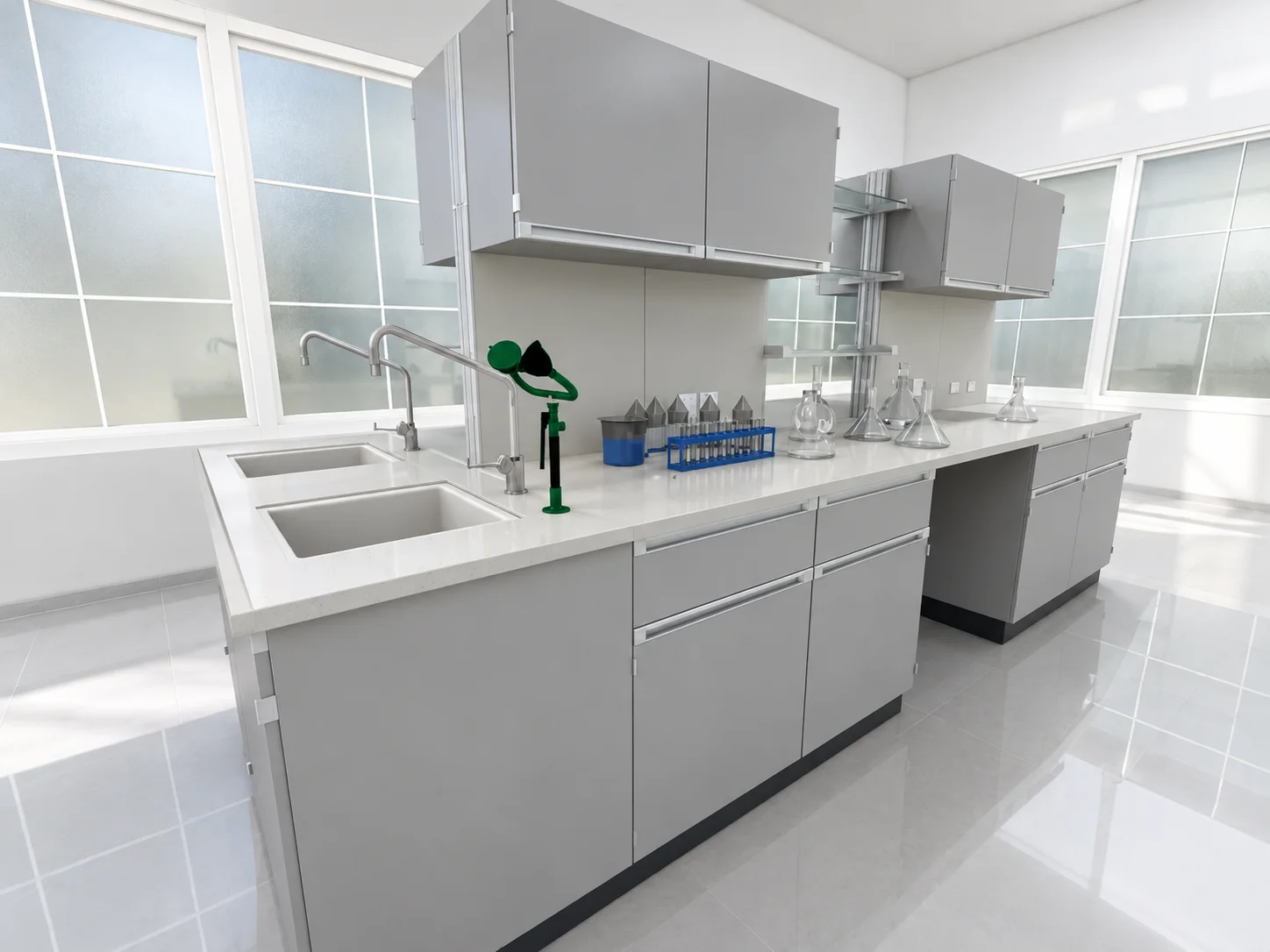
A laboratory sink with cabinet is chosen step by step. First the sink material, for the reagents and the way of washing. Then the number of bowls, the way the sink is fitted in the countertop, and last of all the cabinet. The positions of the water and drain connections are checked from the start, because they fix where the sink goes. Renggli laboratory sinks in polypropylene, monolithic ceramic, stainless steel and epoxy resin come in single-bowl and double-bowl versions, and they are fitted in a laboratory countertop.
How to choose a laboratory sink with cabinet?#
A laboratory sink with cabinet is chosen in four decisions made in order: the sink material, the number of bowls, the way of fitting in the countertop, and the cabinet. The way of fitting depends on the sink material, and the cabinet is chosen to suit the sink and how it is fitted.
The sink is chosen for the reagents and the way of washing, not for the look of the countertop. So before the enquiry, write down what will go into the bowl: reagents with their concentrations, hot liquids, and the kind of glassware and equipment to be washed.
Check the positions of the water and drain connections from the start as well. The sink with cabinet stands next to them, so they set the layout of the furniture run, that is the row of cabinets and tables in the laboratory.
One bowl or two in a laboratory sink?#
The number of bowls is set by the procedures at the sink and, in medical facilities, by regulations too. The Health Ministry regulation on premises of a medical entity (opens in a new tab) has a requirement for the sterilisation room of an outpatient clinic. Its manual washing and disinfection section must have a washer-disinfector or a double-bowl sink. The same regulation requires a sink with a tap, in addition to hand basins, in examination and treatment rooms where reusable instruments are used.
The hand basin is a separate point. In a medical diagnostic laboratory, the Health Ministry regulation on medical diagnostic laboratories (opens in a new tab) of 16 July 2024 requires at least one hand basin. It must have a tap with hot and cold water. The CDC guidelines for diagnostic laboratories (opens in a new tab) recommend a separate handwashing sink with hot water in each work area.
In the Renggli range, sinks in polypropylene, monolithic ceramic, stainless steel and epoxy resin come in single-bowl and double-bowl versions. There are also models with a drainer and multi-bowl sets for large laboratories. The size and depth of the bowl, that is the basin of the sink, are covered in a separate article: how to choose the size and depth of a sink bowl.
What material to choose for a laboratory sink?#
The sink material is chosen by the reagents and the liquid temperature. Each of the four materials has its strengths and its own way of fitting in the countertop, which affects the cabinet straight away.
| Sink material | What it is good for | Fitting in the countertop |
|---|---|---|
| Polypropylene | acids and alkalis including HF, dyes, solvents | fixed from underneath the countertop, can be built into a polypropylene countertop |
| Monolithic ceramic (dense stoneware) | acids, alkalis, dyes, organic solvents, high temperature | undermount, flush-mounted with the countertop, or overmount |
| Stainless steel | mechanical strength, easy cleaning and disinfection | overmount |
| Epoxy resin | structure without joints, resistance to dyes, solvents and high temperature | self-supporting, fixed from underneath or from above |
For work with hydrofluoric acid, Renggli suggests the polypropylene sink, resistant to acids and alkalis including HF. The ceramic sink is fitted in countertops made of laminated boards, epoxy resin or quartz-granite composite. Stainless steel is chosen where hygiene and frequent washing matter, for example in medical laboratories.
What cabinet for a laboratory sink?#
The cabinet under the sink is chosen to suit the furniture system and the way the sink is fitted, because the bowl, the trap and the connections must all fit under the countertop. Renggli furniture is built in the modular RL system, and the number in the system name tells how the cabinets and services are hung under the countertop.
Cabinets can stand on a plinth, hang under the countertop with a gap above the floor, or be mobile under a stable frame. Mobile cabinets let you change the layout quickly. When the services run from the ceiling (ceiling-mounted installation), tables and cabinets can be fully rearranged. A non-standard layout is designed from scratch for the client.
The frames of the RL system are powder-coated steel profiles with an epoxy resin coating. For work with strongly corrosive substances, Renggli makes furniture from PP and PVC plastics, and for sterile conditions from stainless steel. According to the laboratory furniture page, a raised countertop edge holds up to 5 litres of spilled liquid and protects the services under the countertop.
What to settle about the installation before ordering?#
Before ordering, settle where the water and drain connections are, what water should flow from the tap, and where the wastewater will go. For a chemistry laboratory in institutions, the WSSE guidelines from Rzeszów (opens in a new tab) (the regional sanitary and epidemiological station) require a sink with running hot and cold water, where hands can be washed after work with hazardous substances. The same guidelines recommend eye-wash showers (eyewash stations) connected to cold water.
According to the answer on installations in the Renggli FAQ, chemical drainage (carrying wastewater with reagents) is run in PP-H or PVDF pipes with a fall of 1.5 to 2%. PP-H is a type of polypropylene, and PVDF is a fluoropolymer. The sink outlet and trap are planned together with the route of these pipes under the cabinet.
Wastewater from the sink goes to the municipal sewer on the conditions set in the regulation on discharging wastewater into the sewer system. The regulation on the conditions for discharging wastewater into sewerage facilities (opens in a new tab) (ISAP) allows industrial wastewater to be discharged into the sewer if all of its conditions are met. In the same regulation (opens in a new tab), one of them says that the temperature of the wastewater does not exceed 35 °C and its pH is between 6.5 and 9.5, except for wastewater containing cyanides and sulphides, for which the pH is between 8 and 10. The regulation also forbids diluting wastewater with water to reach the permitted values. So before ordering, settle whether the wastewater from the sink needs neutralisation, that is bringing the pH into the range given in the regulation.
What to check before ordering a sink with cabinet?#
This checklist gathers the decisions from the previous sections in the order in which they are made before the enquiry.
Write down what will go into the sink
Reagents with concentrations, hot liquids, glassware and equipment to be washed. The choice of sink material rests on this list.
Set the number of bowls
One or two bowls, possibly a drainer. Plan the hand basin separately if a regulation or procedure requires it.
Choose the way of fitting together with the countertop
Undermount, flush-mounted, overmount or fixed from underneath: the way depends on the sink material.
Measure the space for the cabinet
The length of the wall, the positions of the water and drain connections, and the height of the countertop at which people work standing.
Set the services at the sink
Cold and hot water, demineralised water, chemical drainage and an eye-wash shower nearby.
Check where the wastewater goes
Check whether the wastewater from the sink will meet the conditions of the regulation on discharging wastewater into the sewer system, or whether it needs neutralisation before the municipal sewer.
Prepare the data for the enquiry
A plan of the room or its dimensions, a list of workstations and information about the services.
How Renggli solves it#
We design the sink with cabinet as part of the furniture run: the furniture is made to the dimensions of the room, but always in the modular RL system, so the parts stay interchangeable. We can make every sink to individual order, including with a drainer or as a multi-bowl set. The furniture layout and the visualisation are produced before the quotation, so it is clear what you are paying for.
Our team installs it: the furniture is levelled, the services are connected, and after installation we issue a handover protocol. Laboratory furniture is responsible for people's safety, so it is checked by a standard, not by the manufacturer's declaration, as we write on the Our company page. Our furniture systems hold a current PZH attestation (Polish National Institute of Public Health).
Frequently asked questions#
The cabinet width follows from the size of the sink, the number of bowls and the way of fitting, and in Renggli furniture also from the module of the RL system. Send the dimensions of the space and the chosen sink with the enquiry, and the designer will match the cabinet to it.
The cabinet is chosen for what may drip on it. For strongly corrosive substances, Renggli makes furniture from PP and PVC plastics, and for sterile conditions from stainless steel. The raised countertop edge holds spilled liquid before it reaches the services under the countertop.
Renggli installs the furniture with its own team and hands over the room with the services connected. After installation it issues a handover protocol.
Yes, every Renggli sink can be made to individual order, matched to the workstation and the kind of analyses. The cabinet is made to the dimensions of the room in the modular RL system.