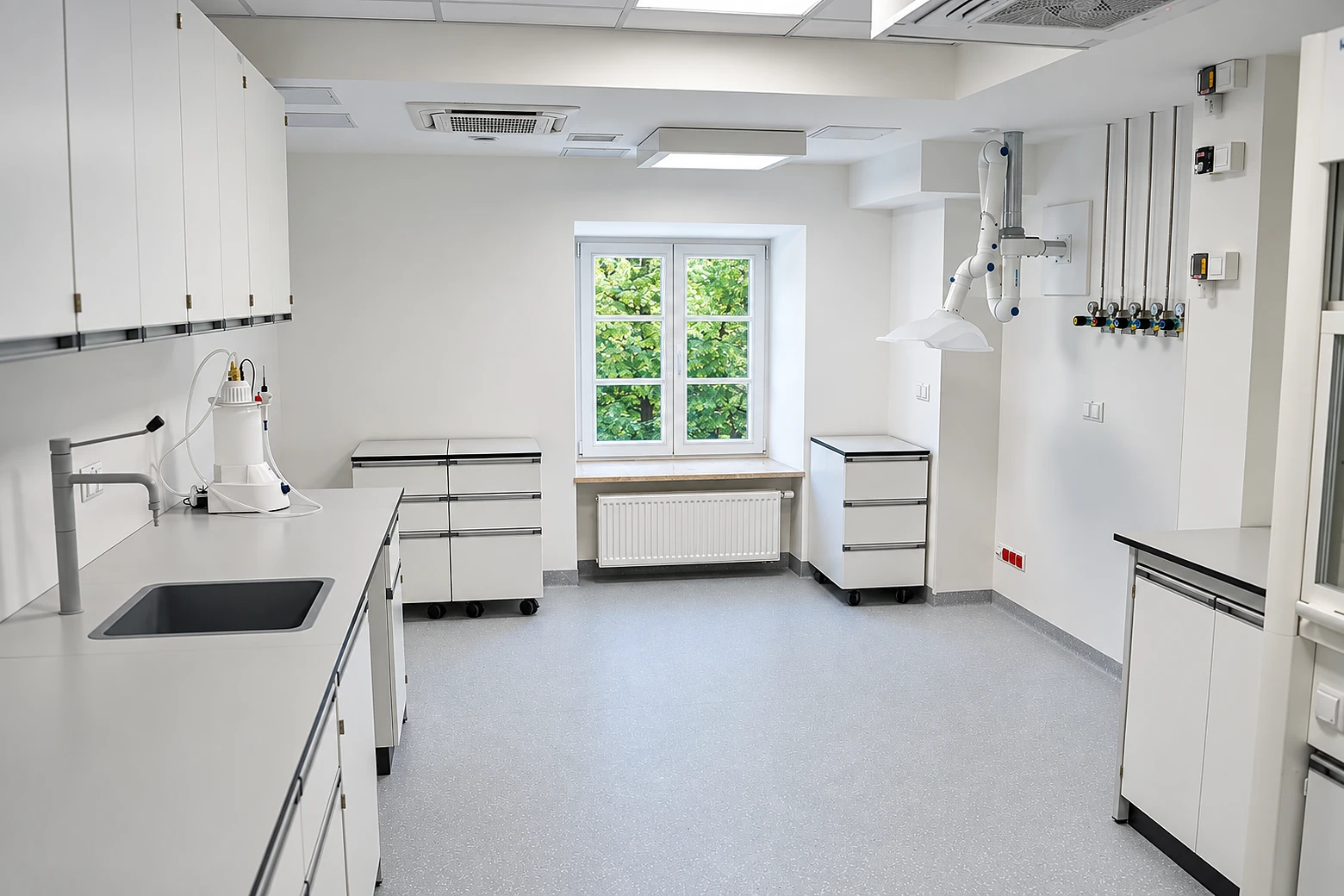
Chemistry Lab and School Laboratory Furniture
Furniture for a school chemistry lab has to withstand the same conditions as in a professional laboratory: reagents, water, the heat of a burner and daily cleaning, plus a dozen or more students working at the same time. In Białystok, Renggli designs and manufactures the benches, worktops, sinks, laboratory fume hoods and reagent cabinets that make up a chemistry, biology and physics lab.
What goes into a school lab
- Chemistry lab: student benches and a teacher's demonstration bench, reagent-resistant worktops, laboratory sinks, a fume hood and a reagent cabinet.
- Biology lab: benches for microscope work, a sink, easy-to-clean surfaces, cupboards for specimens and glassware.
- Physics lab: benches with access to power, space for experiment kits, cabinets for teaching aids.
- University laboratory: the same elements at research scale, described on the universities and research institutes page.
Furniture for a chemistry lab
A chemistry lab bench consists of a frame, a worktop and the cabinets beneath it, and at experiment stations also a sink and service connections. Renggli furniture stands on steel profiles powder-coated with epoxy resin and is built within the modular RL laboratory furniture system, so a station can be added or rearranged later.
The worktop is what determines durability. For work with concentrated acids, the safest choices are monolithic ceramic or epoxy resin. HPL laminate is lighter and less expensive, and laminate furniture performs well in schools for typical experiments. We offer laboratory worktops in seven materials.
A laboratory sink is chosen to suit the reagents and the way it will be used for washing. Polypropylene withstands acids and alkalis, ceramic is heat- and acid-resistant, and stainless steel is the easiest to maintain. For washing measuring cylinders and flasks, plan a bowl at least 300 mm deep.
Fume hoods in schools
A fume hood (fume cupboard) protects students and the teacher from vapours, gases and dust given off during experiments. The ducted version exhausts air through a duct to the outside of the building. Where an exhaust duct is difficult to route in an older building, the LabAirTec Green ductless fume hood does the job: it cleans the air with filters and needs no connection to the ventilation system. Our fume hoods meet EN 14175. What to look for when choosing one is covered in the article fume hoods in school laboratories.
Storing reagents in schools
The Polish regulation on health and safety in public and non-public schools and educational institutions (Journal of Laws 2020, item 1604, § 29) requires chemical substances to be kept in labelled containers, and hazardous substances and mixtures in closed rooms specially adapted for that purpose. The head teacher makes the safety data sheets for these substances available to the staff who run the classes.
Flammable reagents belong in fire-resistant safety storage cabinets compliant with EN 14470-1, rated for 30 or 90 minutes. Acids, alkalis and other non-flammable chemicals are kept in chemical storage cabinets compliant with EN 16121 and EN 16122.
Workstations sized for students
The same regulation (§ 24) states that workstations must be adapted to the anthropometric characteristics of the students. In practice, this means worktop and seat height: for seated work the worktop is usually 75 to 85 cm high, for standing work 90 to 100 cm. Laboratory stools adjust from 420 to 550 mm or from 560 to 690 mm.
How schools buy
Public schools in Poland usually buy lab furniture through public procurement, with a description of the subject of the contract, the required standards and the award criteria. The standard for school lab benches is EN 13150:2020-07, "Workbenches for laboratories in educational institutions"; all the standards our furniture complies with are listed on the standards and certificates page. Which criteria to score besides price is covered in the article tendering for laboratory furniture.
Frequently asked questions
The price depends on the version (ducted or ductless), the width, the materials of the chamber and worktop, and whether the fume hood has to be connected to the building's ventilation. For a quote, a floor plan of the room, details of the ventilation and a list of experiments are enough. We break down the price factors on the prices and quotes page.
A ductless fume hood needs no ventilation duct, so it is easier to move when the lab layout changes.
The basis is the Polish regulation on health and safety in public and non-public schools and educational institutions (Journal of Laws 2020, item 1604). Workstations are adapted to the anthropometric characteristics of the students (§ 24), the lab's health and safety rules are put on display (§ 26), and hazardous substances are stored in closed, purpose-adapted rooms (§ 29).
For concentrated acids, monolithic ceramic or epoxy resin; for typical school experiments, HPL laminate, which is lighter and less expensive. The worktop should be chosen for what actually happens at the station.
Polypropylene if the lab uses acids and alkalis, ceramic if heat resistance matters, stainless steel if easy cleaning is the priority. A bowl for washing glassware is at least 300 mm deep.
Stay up to date with Renggli
New projects, products and guides on laboratory furniture, in one place.
Let us plan your laboratory
Tell us what has to happen in the room. We will pick the furniture and work out the rest.
Free project quote.