Lab tables for instruments: how to choose them
Lab tables for instruments: how to choose a table for an analytical balance, microscope and analyser, where to place it and what to settle before ordering.
 Renggli TeamEditorial team
Published: Reading time: 7 min read
Contents
Lab tables for instruments are chosen to suit the device that will stand on them. For an analytical balance you plan a weighing table, in which the balance has its own base, separate from the work surface. According to the Renggli weighing tables page, such a table is planned when the balance reading has to be repeatable to 0.1 mg. A microscope needs a level surface free of vibration, and an analyser needs a load-bearing frame and utilities.
Which laboratory table to choose for an analytical balance?#
For an analytical balance, choose a table that does not shift or sag, ideally one that gives the balance its own base, if at all possible. This is how the NATA guidelines on checking laboratory balances (opens in a new tab), from the Australian laboratory accreditation body, describe best practice. According to these guidelines, a table that sags under a heavy object can change the balance reading. The guidelines also recommend not placing the balance on a metal surface, which can affect the balance magnetically.
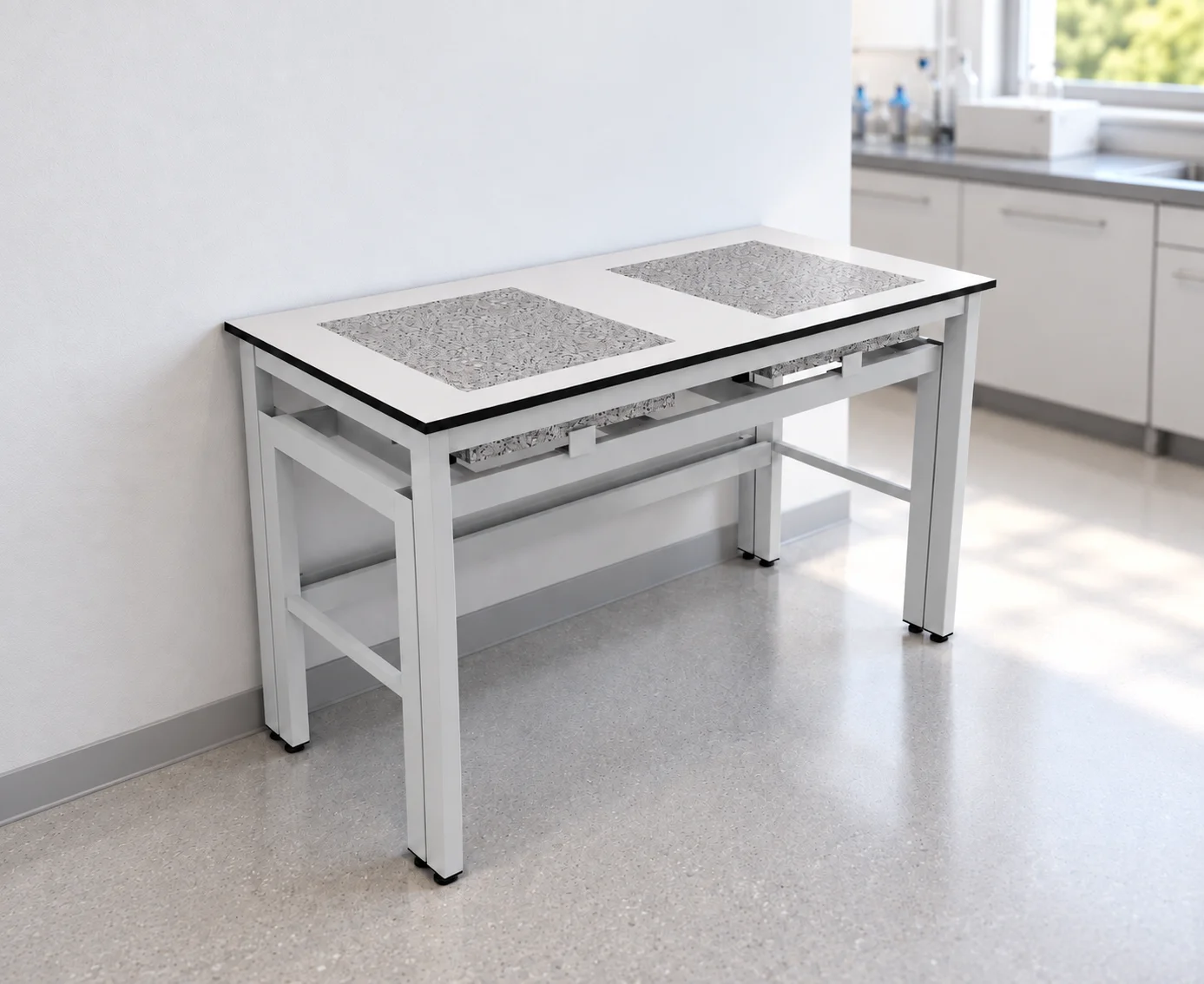
A weighing table gives the balance its own base thanks to a “table within a table” construction. It has two independent parts: the work surface at which the operator works, and an inner base that carries the weighing plate with the balance. A gap (expansion joint) separates the work surface from the base, so leaning on the work surface does not pass vibration to the balance. The weighing plate is most often made of high-density granite.
Which table for a microscope?#
A microscope is placed on a surface that is free of vibration, level and non-combustible, as required by the ZEISS Axiovert microscope manual (opens in a new tab). The manual also requires the microscope to stand firmly and not be able to slide or fall off the table. It recommends placing it away from radiators and windows with direct sunlight. Before ordering a table, check these requirements in the manual of your own microscope.
For long hours of work, the ergonomics of the workstation also matter. The RLM Motion table for work with a microscope has three movable countertops, each with height adjustment. The microscope countertop is mobile, so the microscope is easy to move and the electrical sockets are easy to reach. The table also has soft armrests and built-in sockets, so cables do not lie on the countertops.
Which table for an analyser and heavier equipment?#
For an analyser and other heavier benchtop equipment, the frame (the load-bearing structure of the table) is matched to the mass, dimensions and utilities of the device. Utilities are the installations brought to the workstation, for example electricity, water, gases and the computer network. According to the Renggli FAQ, a standard table carries about 200 kg per running metre of table length, and heavier devices require reinforcement. That is why a list of the equipment that will stand on the tables is attached to a furniture enquiry.
According to the NATA guidelines, many benches, including steel benches, can bend or move enough to affect the readings of a balance, e.g. by placing a heavy article on the bench. For measurement workstations, power supply, sockets with increased ingress protection and network cabling are also planned before the table design is drawn up.
Where to place a table for vibration-sensitive equipment?#
A table for an analytical balance is placed in a corner by a load-bearing wall, preferably on the ground floor or on the lowest foundation slab. It is levelled with independent threaded feet with rubber pads, so that no stress is introduced into the structure. More on choosing the location is in the post how to choose a weighing table and eliminate vibrations.
Air movement and temperature also affect the balance reading. The NIST guidelines on factors affecting weighing (opens in a new tab) recommend a laboratory with good control of temperature and humidity. The balance is placed where the air is still, away from heating and cooling air supply. According to the NATA guidelines, the operation of the balance is also affected by opening doors and windows and by running fans and air conditioning.
What to settle before ordering lab tables for instruments?#
Before ordering, settle which devices will stand on the tables, what disturbs their operation and where they will stand in the room. The table gathers requirements from the NATA and NIST guidelines, the ZEISS manual and the Renggli FAQ.
| Equipment | What disturbs operation | What the device stands on |
|---|---|---|
| Analytical balance | vibration, table sag, air movement, metal surface | weighing plate on its own base, separated from the work surface |
| Microscope | vibration, uneven surface, heat from a radiator and sun | level, non-combustible surface free of vibration |
| Analyser and heavier equipment | mass and dimensions of the device, access to utilities | frame matched to the mass, reinforced if needed |
Checklist before ordering:
- List the equipment: model, dimensions, mass and utilities of each device.
- Mark the analytical balances and microscopes, because they need different workstations from the rest of the equipment.
- Compare the mass of the devices per running metre of table length with the load capacity of the table.
- Mark the place on the plan: a corner by a load-bearing wall, away from doors, windows, air supply and radiators.
- Settle the number of weighing stations and whether a cabinet for accessories should stand next to them.
- Settle the working height, seated or standing, and whether the countertops should have height adjustment.
- List the cleaning and disinfecting agents that will be used on the workstation.
How Renggli solves this#
We produce weighing tables in four variants: single-station with or without an enclosed frame, single-station with a mobile cabinet, and two-station. The version with an enclosed frame is chosen when the weighing table stands in a technological line (a row of laboratory furniture) and is meant to match the neighbouring cabinets structurally. The two-station table serves two measuring devices and damps vibration at each station. We coat the frames with protective coatings against corrosion and contact with substances used in sample preparation.
For work at a microscope we offer microscope tables. The laboratory tables we produce are tested against the EN 13150 standard, not just the manufacturer's declaration, as we write on the Our company page. We install and level the furniture on site, and after installation we issue a handover report.
Frequently asked questions#
According to the NATA guidelines, the best practice is to isolate the balance on its own support, if at all possible. A microscope gets a separate table with a level surface free of vibration. For two balances side by side we offer a two-station weighing table.
A balance is placed on a table that does not shift or sag, as the NATA guidelines recommend. A cabinet for documentation and accessories can stand on castors, placed next to the weighing table, outside the weighing plate.
A granite weighing plate is cleaned only with pH-neutral agents intended for natural stone. This is what we advise in the FAQ section on countertop care.
A weighing table is levelled with independent threaded feet with rubber pads, so that no stress is introduced into the structure. During installation we level the furniture on site.