Which treatment room sink to choose?
Which treatment room sink? Stainless steel, built into the units beside the handwash basin. We cover the steel grade, bowl, sink cabinet and cleaning.
 Renggli TeamEditorial team
Published: Reading time: 8 min read
Contents
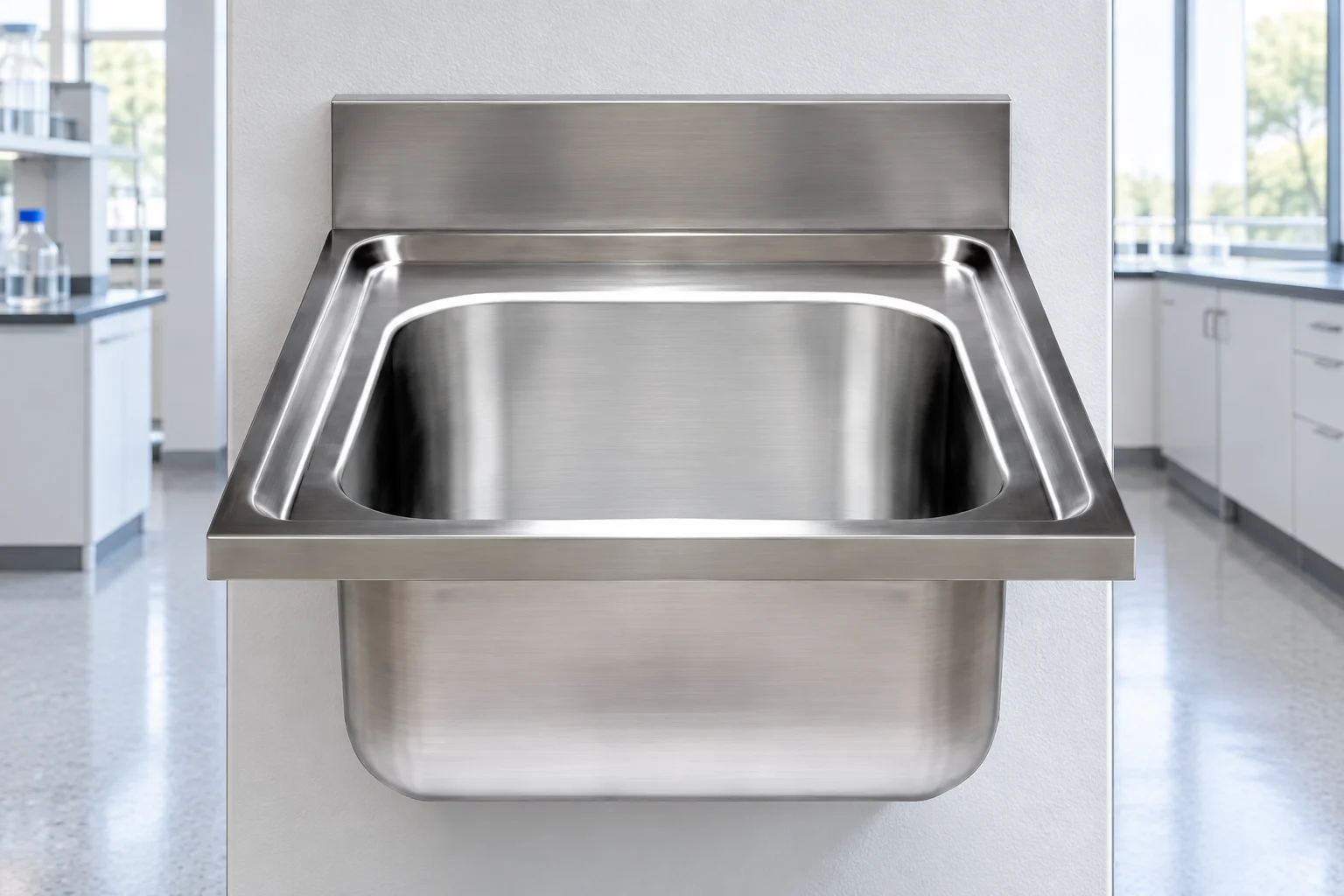
A treatment room gets a steel sink, because it is in daily contact with water and disinfectants. Stainless steel has a smooth, non-porous surface that is easy to clean, which is why medical furniture uses it for work countertops (the work surfaces next to the sink) and cabinets as well. Which treatment room sink to order also depends on what is washed in it and with which products.
Which treatment room sink withstands daily disinfection?#
A stainless steel sink withstands daily disinfection, because it is a material made for constant contact with water and cleaning products. The sink stands in the built-in units, that is, a set of furniture fitted to the treatment room, next to the handwash basin. The work countertop by the basin and the cabinets in the treatment room are also made of stainless steel. Powder-coated sheet steel (steel coated with powder paint) works well in document cabinets and shelving, which are washed regularly but do not stand in damp conditions.
| Element of the built-in units | Material | Why |
|---|---|---|
| Sink and work countertop by the basin | stainless steel | daily contact with water and disinfectants |
| Cabinets in the treatment room | stainless steel | frequent cleaning and disinfection |
| Document cabinets, shelving | powder-coated sheet steel | regular cleaning, no constant damp |
In a laboratory where chemical reagents are used at the sink, the sink material is chosen to suit the reagents and the way of cleaning. For such laboratories we offer laboratory sinks, including ones made of polypropylene, monolithic ceramic and epoxy resin.
Which stainless steel grade to choose for a sink?#
For a sink in an area of frequent disinfection, choose a steel grade with added molybdenum, because it resists pitting corrosion (corrosion in small spots) better. According to the Outokumpu Supra datasheet (opens in a new tab) (a line of grades for highly corrosive environments), pitting and crevice corrosion usually appear in acidic or neutral chloride solutions. The same datasheet states that resistance to it grows with the content of chromium, molybdenum and nitrogen.
According to the Outokumpu Core datasheet (opens in a new tab), grade 304 is a classic austenitic steel (chromium-nickel) with 18% chromium and added nickel. It is the basic grade, without added molybdenum. The datasheet describes separately the grades with molybdenum, and some also with copper, which resist corrosion better than the basic grade. The steel grade is set together with the list of products the treatment room uses to clean and disinfect surfaces.
What to use to clean and disinfect a stainless steel sink?#
For stainless steel, disinfectants based on alcohol or active oxygen are recommended. Such products do not damage the passive protective layer, that is, the thin oxide layer that protects steel from corrosion. For daily cleaning, a soft cloth and a mild pH-neutral detergent are enough. Every product must be removed completely after cleaning by rinsing the surface with clean water, as required by the Aperam Uginox guide to cleaning stainless steel (opens in a new tab).
Clean the bowl and countertop with a soft cloth
A mild pH-neutral detergent is enough for cleaning; the countertop around the sink is cleaned the same way.
Disinfect with a product suited to steel
A product based on alcohol or active oxygen, following the product manufacturer's instructions.
Rinse the sink and countertop with clean water
No product residue stays on the surface, including the corners of the bowl and around the drain.
How to choose the size and depth of the bowl?#
The bowl is sized to the largest container, tray or vessel that has to fit in it whole. For comparison: in a laboratory, a bowl at least 300 mm deep is planned for washing cylinders and flasks, as we state in our FAQ on laboratory sinks. That value is for a laboratory sink, not a measure for a treatment room. In a treatment room, the measure is the largest container for washing instruments. The container must also fit in the bowl under the tap spout (the end from which the water flows).
Bowl dimensions and their effect on the cabinet are described in our guide to laboratory sink bowl dimensions.
How to plan a sink in the cabinet and the built-in units of a treatment room?#
A treatment room sink is planned together with the work countertop by the basin, and the sink cabinet is made of materials resistant to disinfectants. The furniture of the room is arranged around this spot, so the position of the sink is decided on the floor plan of the room, before the cabinets are made. Cleaning is easier thanks to the construction: wall-hung cabinets or cabinets on high legs leave the floor clear, and mobile cabinets have castors with a lock.
Water and sewage connections are marked on the drawing of the built-in units, and clashes between the installation and the cabinets are caught in the spatial design prepared by the furniture manufacturer before installation starts. The sink cabinet needs free space for the trap and valves, so that they can be reached without dismantling the furniture.
What to settle before ordering a sink for a treatment room?#
Before ordering, five things are settled: the place for the built-in units, the largest container to wash, the products for cleaning and disinfection, the water and sewage connections, and the sink cabinet. This list is enough to request a quote for a sink together with the built-in units.
Measure and mark the place for the built-in units
Mark the handwash basin, the sink and the work countertop on the floor plan of the room.
Measure the largest container to wash
The width and depth of the bowl depend on it.
List the products for cleaning and disinfection
The list of products helps to choose the steel grade of the sink and countertop.
Mark the water and sewage connections
The position of the connections decides where the sink cabinet will stand.
Choose the sink cabinet
A cabinet standing on legs or wall-hung, with access to the trap and valves.
How Renggli solves it#
For treatment rooms we offer a stainless steel sink in built-in units with a work countertop and medical cabinets made of materials resistant to disinfectants. We prepare the built-in units for the specific room: to quote, a floor plan or the dimensions of the room, a list of workstations and information about utilities are enough.
The furniture design is free of charge when the client orders furniture from us, and it includes technical drawings and visualisations of the built-in units. Our team does the installation: we hand over the room with levelled furniture and connected utilities, at the sink with water and sewage. After installation we issue a handover protocol.
Frequently asked questions#
Stainless steel, because it has a smooth, non-porous surface that is easy to clean and disinfect. For areas with high humidity and frequent disinfection, steel grades with added molybdenum are chosen.
In a treatment room the sink is chosen above all for daily cleaning and disinfection, in a laboratory for the reagents the workstation uses. We describe the laboratory sink in our guide to the laboratory sink with a cabinet.
Deep enough for the largest container or instrument tray to fit in it whole. The container dimension is attached to the enquiry together with the dimensions of the place in the built-in units.
Yes, stainless steel withstands daily cleaning and disinfection if the product is suited to the material. Products based on alcohol or active oxygen are recommended, and after cleaning the surface is rinsed with clean water.