Chemical storage cabinets for schools: how to choose
Chemical storage cabinets for schools depend on what goes in them: flammable liquids, or acids and alkalis. How do you settle ventilation, size and lock?
 Renggli TeamEditorial team
Published: Reading time: 10 min read
Contents
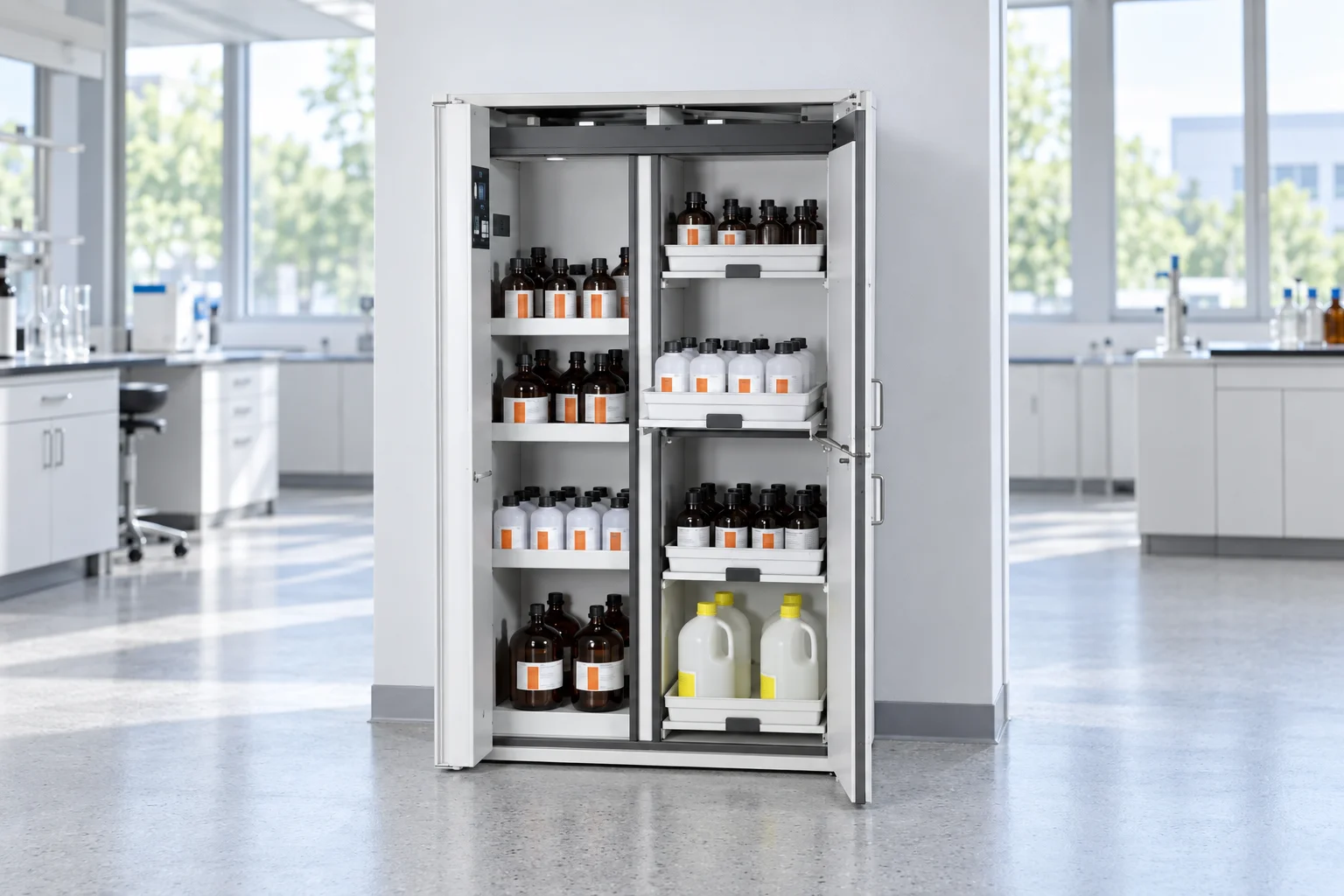
Chemical storage cabinets for schools are chosen to match the groups of reagents in the prep room. Alcohols and solvents go in a fire safety storage cabinet (fire-resistant, to EN 14470-1), while acids and alkalis go in an acid and alkali cabinet (a cabinet for non-flammable chemicals) with a corrosion-resistant interior. Both types are in the category laboratory chemical storage cabinets. Before ordering, you also settle where the cabinet will stand, how it connects to extraction and who holds the key.
Which chemical storage cabinets for schools should you choose?#
The type of cabinet follows from the reagents it is meant to hold. Each group of reagents from the prep room is assigned to one cabinet type:
| Reagents in the lab | Cabinet type | What to check |
|---|---|---|
| Flammable liquids: alcohols, solvents | fire safety storage cabinet for flammable liquids | fire resistance type to EN 14470-1 and the test documentation |
| Acids, alkalis and their solutions | acid and alkali cabinet | compliance with EN 16121 and EN 16122, spill trays |
| Non-flammable reagents that give off fumes | ventilated cabinet with a filter | activated carbon filter, polypropylene spill trays on the shelves |
If the inventory lists only acids, alkalis and their solutions, an acid and alkali cabinet is enough for the lab. If the inventory also includes alcohols or solvents, a second cabinet is needed: a fire safety storage cabinet for flammable liquids. An acid and alkali cabinet is designed against corrosion and a fire safety storage cabinet against fire, so one does not take over the job of the other.
Does a school chemical storage cabinet have to be fire-resistant?#
Flammable liquids, such as alcohols and solvents, are stored in a fire safety storage cabinet tested to EN 14470-1. The guidelines of the Voivodeship Sanitary and Epidemiological Station in Rzeszów (opens in a new tab) say that hazardous substances in a chemistry lab must be kept in closed rooms and in containers made for that purpose. The same guidelines recommend buying suitable cabinets.
In a fire, a fire safety storage cabinet closes its doors by itself, and the dampers in its ventilation connection close the air ducts. This happens without power and without anyone acting. The number in the type is the time in minutes for which the cabinet isolates its contents from the fire, as the page on type 30 fire safety storage cabinets explains. Such a cabinet is enough for smaller quantities of flammable liquids, while larger stocks of solvents call for 90-minute fire safety storage cabinets. The type is decided by the safety data sheets of the substances and the quantities in the reagent inventory.
For acids and alkalis, what counts is the resistance of the interior to fumes and corrosion, which is why they go in an acid and alkali cabinet. The fire resistance type of a fire safety storage cabinet is confirmed by the marking to EN 14470-1 and the cabinet’s test documentation from the furnace test, not by a trade name. The Polish Committee for Standardization keeps a catalogue entry for the standard PN-EN 14470-1:2023-12 (opens in a new tab) titled “Fire safety storage cabinets, Part 1: Safety storage cabinets for flammable liquids”.
Which reagents can be kept together in one cabinet?#
Reagents that do not react with each other can stand together, and the safety data sheet (SDS) of each substance decides which those are. The CIOP-PIB guide to safe work in chemical stores (opens in a new tab) points out that chemicals of some classes must not be stored together. For small quantities of chemicals, the institute recommends separating those that may react with each other, on the basis of the safety data sheet.
Acids are not put on the same shelf as alkalis, because in a spill they react with each other, giving off heat and fumes. The minimum is separate shelves with their own spill trays in one cabinet, and the safest option is separate compartments or separate cabinets. How to lay out the shelves is described in our text on how to organise storing acids and alkalis.
If the prep room has space for only one cabinet, the K-Phoenix-30 fire safety storage cabinet holds two groups of substances: flammable liquids and a second group of hazardous chemicals. It has an insert that absorbs spills of two types of substances. Before the second group goes into this cabinet, check in the safety data sheets that it does not react with flammable liquids.
Does a school chemical storage cabinet need extraction?#
Whether the cabinet is connected to extraction is decided by the risk assessment for the stored substances. The fire safety storage cabinets and the acid and alkali cabinets in our range have built-in air ducts ready for such a connection. Extraction removes the fumes from the interior before they reach the room when the door is opened. The model data sheets give the recommended air extraction in m³/h, so the installer knows what flow to prepare.
Where it is hard to run an extraction duct to the prep room, a ventilated cabinet with a filter works well. A unit with a fan and an activated carbon filter sits on top of the cabinet and passes the air from the interior through the filter. As a result the cabinet works without a connection to the building’s ventilation. It is meant for reagents that give off fumes but are not flammable: concentrated acids, alkalis and other volatile substances.
The filter cartridge is replaced according to the filter manufacturer’s recommendations and the results of saturation checks. It is worth recording the replacement date and the list of substances in the cabinet, because at the next inspection it is easier to judge whether the filter is wearing out faster than usual. Flammable liquids stay in the fire safety storage cabinet even when the lab has a ventilated cabinet.
How do you keep students out of the cabinet?#
The cabinet with reagents is locked with a key held only by the person responsible for the lab. Among the general rules for small quantities of chemicals, the CIOP-PIB guide (opens in a new tab) recommends limiting access by unauthorised people. Before ordering, it is therefore worth settling how many keys are needed and who keeps them.
The fire safety storage cabinets we offer have a cylinder lock and a closure indicator, red or green. The teacher can see from the doorway whether the door is closed. The CS-Classic acid and alkali cabinet has a steel body and, like the fire safety storage cabinets, a cylinder lock. In it, acids and alkalis are kept under lock and key in the same way as solvents in a fire safety storage cabinet.
How big a cabinet is enough for a school lab?#
The size of the cabinet is worked out from the reagent inventory: the number of containers in each group and the height of the largest bottles. Before the inventory is drawn up, it is worth going through the stock. The WSSE Rzeszów guidelines (opens in a new tab) recommend that expired and unlabelled substances should not be kept in cabinets for years, but handed over for disposal as soon as possible.
We make acid and alkali cabinets in a tall version, 1965 mm high, and an under-counter version (low, to stand under a table), 600 mm high. The under-counter cabinet suits places where the reagents are meant to stand under the teacher’s table. We also have an under-counter fire safety storage cabinet for flammable liquids, for when they are meant to stand right at the table.
It is safest to keep acids and alkalis in separate cabinets. If only one cabinet fits in the prep room, plan separate shelves with spill trays in it for each of these groups. Our acid and alkali cabinets and ventilated cabinets have pull-out shelves, so bottles from the back row can be taken out without reaching deep into the cabinet.
What should you check when ordering a school cabinet?#
Before ordering you need the reagent inventory, the place for the cabinet and whether there is an extraction duct near it. This checklist takes you through those points in order:
List the reagents and divide them into groups
Flammable liquids, acids, alkalis and volatile reagents; check the safety data sheet for each group.
Hand expired and unlabelled reagents over for disposal
Match a cabinet type to each group
A fire safety storage cabinet to EN 14470-1, an acid and alkali cabinet to EN 16121 and EN 16122, or a ventilated cabinet with a filter.
Check whether there is an extraction duct at the cabinet’s place
Place the cabinet away from the main escape routes
This is how a cabinet of any type is placed, so its position is settled together with the rest of the lab furniture.
Protect the cabinet from the sun and heat sources
CIOP-PIB recommends protecting chemicals from heating by the sun and other heat sources.
Decide who keeps the keys to the cabinet
Measure the doors and corridor the cabinet will pass through to reach the prep room
We help match the type and model of cabinet to the substances in such an inventory and to the room. In the order description for a fire safety storage cabinet, it is worth stating compliance with EN 14470-1, the fire resistance type and the cabinet’s test documentation. For an acid and alkali cabinet, state compliance with EN 16121 and EN 16122 and spill trays on the shelves.
Frequently asked questions#
Whether the cabinet is connected to extraction is decided by the risk assessment for the stored substances. Fire safety storage cabinets and acid and alkali cabinets have ducts ready for connection, and where a duct is hard to run, a ventilated cabinet with an activated carbon filter is used.
In the safety data sheet of the substance. According to the CIOP-PIB guide, the hazards of storage are determined from it, and chemicals that may react with each other are separated.
Solvents and alcohols go in a fire safety storage cabinet to EN 14470-1, because it protects flammable liquids from fire. An acid and alkali cabinet has an interior and fittings resistant to corrosion, so it is for corrosive reagents.
Hand them over for disposal as soon as possible. This is what the WSSE Rzeszów guidelines recommend for substances that sit in cabinets past their expiry date or without labels.