Stainless steel laboratory table: how to choose one
A stainless steel laboratory table suits wet work and frequent cleaning. How do you choose the steel grade, what cleans the top and what goes in the enquiry?
 Renggli TeamEditorial team
Published: Reading time: 8 min read
Contents
A stainless steel laboratory table is the choice where the top is often wet, washed and disinfected: in wet, medical and microbiology laboratories. The list of reagents and disinfectants at the workstation decides the choice, because the steel grade depends on it. Such a table is part of a laboratory furniture system with cabinets and utilities.
What work is a stainless steel laboratory table suited to?#
A stainless steel table suits work where hygiene and frequent cleaning of the top matter. Our FAQ names wet, medical and microbiology laboratories here. These are workstations where water is present and the top is cleaned after every batch of work.
In microbiology and diagnostic laboratories, easy cleaning under the table matters too. That is why the RL5 system with wall-hung cabinets, which leaves a gap above the floor, is often chosen.
For work with concentrated acids and solvents, monolithic ceramic or epoxy resin is chosen, and for hydrofluoric acid, polypropylene. All these materials are in the range of laboratory countertops, so in one laboratory a steel table can stand next to a table with a monolithic ceramic top.
What hygiene requirements apply to a laboratory top?#
A laboratory top should be impermeable to water and easy to wash. In Poland this is covered by the regulation of the Minister of Health on harmful biological agents (opens in a new tab) in the working environment, published as a consolidated text in 2026.
The regulation has a table of containment measures (measures that keep biological agents at the place of work). In it, it lists surfaces that are impermeable to water and easy to wash, and surfaces resistant to acids, alkalis, solvents and disinfectants. In the table, the term “recommended” means that the measures should be used unless the results of the occupational risk assessment referred to in § 5 and § 6 of the regulation indicate otherwise.
International guidelines say the same. The WHO Laboratory biosafety manual (opens in a new tab) requires tops that are impermeable to water and resistant to disinfectants, acids, alkalis, organic solvents and moderate heat. The WHO manual also requires laboratory furniture to be chosen for the work done at it.
In cleanrooms, the EU GMP guidelines for sterile medicinal products (opens in a new tab) recommend smooth, impermeable surfaces without cracks. Materials should withstand repeated cleaning, disinfection and sporicidal agents, and there should be no crevices that are hard to clean.
Which stainless steel grade should you choose for a laboratory?#
The steel grade is chosen for what lands on the top, and for chloride solutions the molybdenum addition matters. Corrosion-resistant steel grades are listed in PN-EN 10088-1:2024-06 (opens in a new tab) (“Stainless steels. List of stainless steels”).
The Aperam 304 grade data sheet (opens in a new tab) describes it as well suited to fresh water and to urban and rural atmospheres. According to the Aperam 316L grade data sheet (opens in a new tab), this grade copes well with chloride environments, including pitting corrosion (point losses of material) and crevice corrosion.
Molybdenum and nickel slow the development of pitting and crevice corrosion. The 316L data sheet (opens in a new tab) also lists uses in the chemical and pharmaceutical industries.
| Grade | Molybdenum | What the steel maker's data sheet says |
|---|---|---|
| 304 (opens in a new tab) | none added | good performance in fresh water and in an urban atmosphere |
| 316L (opens in a new tab) | added | very good resistance in chloride environments, to pitting and crevice corrosion |
For a top with welded parts, the treatment of welds matters too. According to the 316L data sheet (opens in a new tab), welds must be cleaned mechanically or chemically and passivated to restore the full corrosion resistance of the steel.
Which reagents does a stainless steel top withstand?#
A stainless steel top copes well with water and frequent cleaning, and the 304 grade data sheet (opens in a new tab) also gives resistance to formic and lactic acid at room temperature. The rest depends on the list of reagents at the workstation, so the top is chosen for that list, not for the name of the material alone.
Chlorides need the most attention, because for them the grade with molybdenum matters. Hydrochloric acid is not used to clean steel: the Uginox stainless steel cleaning guide (opens in a new tab) expressly forbids it. The same guide says to avoid chlorinated products and bleach.
Each countertop material in the range has its own tasks, so the workstations of one laboratory can have different tops:
| Countertop material | Where it works well |
|---|---|
| Stainless steel | hygiene and frequent cleaning: wet, medical and microbiology laboratories |
| Monolithic ceramic | concentrated acids and high temperature |
| Epoxy resin | concentrated acids and solvents |
| Polypropylene | acids and alkalis, including hydrofluoric acid |
| HPL laminate | lighter tasks, a top lighter than ceramic |
How do you clean and disinfect a stainless steel table?#
A steel top is cleaned after every batch of work with a soft cloth and a mild, neutral detergent, then rinsed with clean water. According to the Uginox guide, dirt and stains lower the corrosion resistance of steel, so they must be removed regularly. Every cleaning agent is rinsed off completely.
When cleaning and disinfecting steel, avoid:
- chlorine products, bleach and waxes;
- hot sodium hypochlorite solution (Javel water), even diluted;
- hydrochloric acid;
- abrasive pads and powders, even fine ones.
So the disinfectant is chosen without chlorine and rinsed off with water after its contact time. Spilled concentrated acid is not wiped up dry: first a neutraliser, then a rinse with demineralised water.
How do you match a stainless steel table to the equipment and the laboratory layout?#
The table is matched to the equipment, the working position and the utilities before the top material is chosen. According to the CDC BMBL guidelines (opens in a new tab), laboratory furniture should carry the expected loads. That is why the weight of the equipment is given already in the enquiry: heavier equipment needs a reinforced frame.
The height of the top is set separately for seated and standing work. An analytical balance stands on a separate weighing table, in which the working top is separated from the base under the balance.
A wall-side table runs utilities along the wall and takes up less space than an island table. An island table gives access from two sides and needs utilities brought in from the floor or the ceiling.
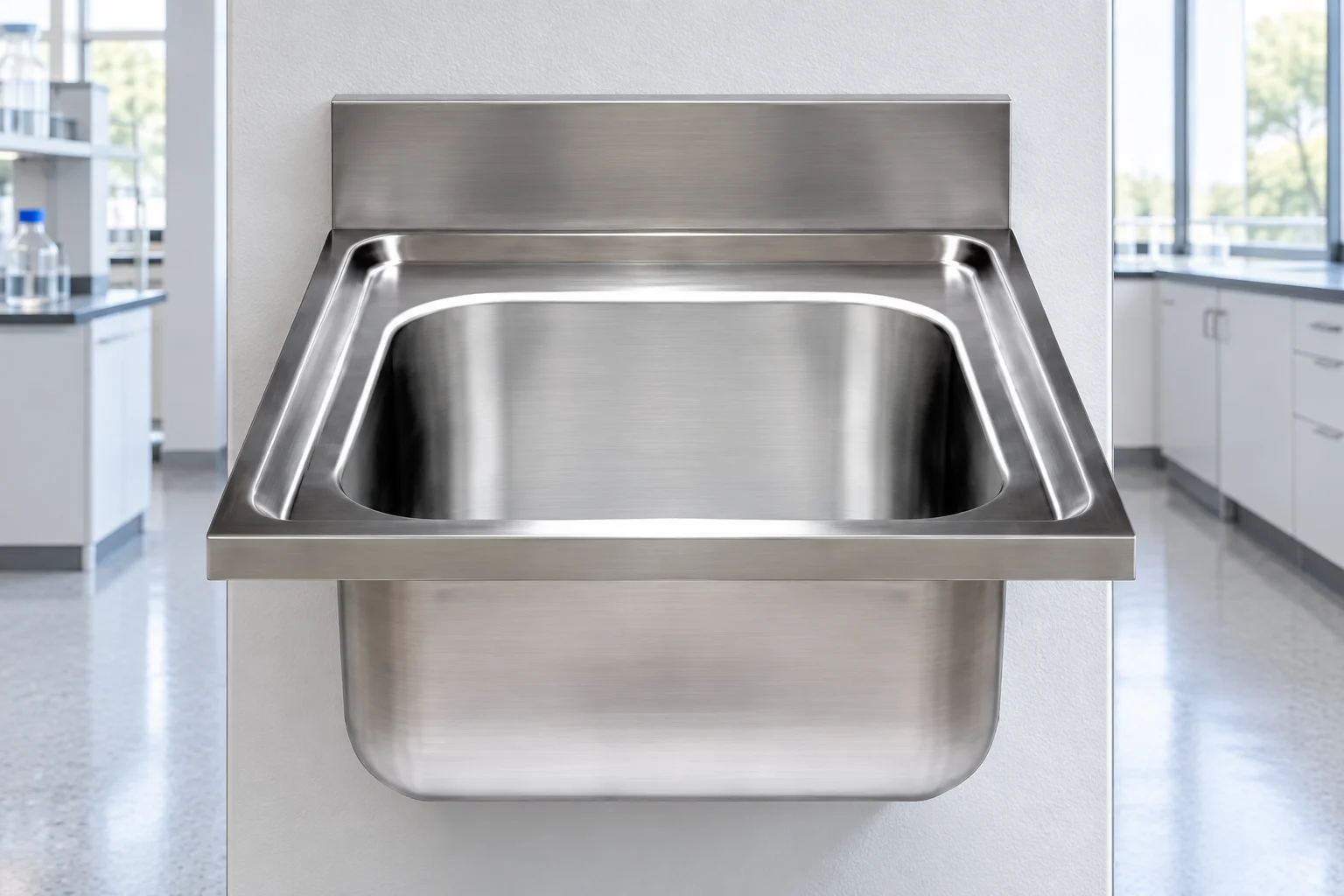
A stainless steel table is often combined with a stainless steel laboratory sink. The top and the basin then form one workstation for wet work.
What should you check when ordering a stainless steel table?#
Stainless steel is one of the chemically resistant materials we list on the Our company page, and we choose the top for what happens at the workstation. We make tables on powder-coated steel frames, in modular RL systems or as an RL Indywidual project. We prepare the furniture design with technical drawings free of charge with the order, and we finish the installation with a handover protocol.
Prepare for the enquiry:
- the list of reagents and disinfectants at the workstation, with concentrations;
- information on whether chloride solutions appear on the top;
- the list of equipment with weight and dimensions;
- the working position: seated or standing;
- utilities: water, drainage, gas, electricity and ventilation;
- the floor plan of the room or its dimensions.
Frequently asked questions#
An analytical balance is placed on a separate weighing table, in which the working top is separated from the base under the balance. This way leaning on the top does not transmit vibration to the balance.
A laboratory table is designed for work with reagents. The top is chosen for the reagents and disinfectants of the laboratory, and the table often has a superstructure (a frame above the top with utility sockets and valves). The standard PN-EN 13150:2020-07 (opens in a new tab) covers workbenches, mobile workbenches and workbench shelves intended for use in educational institutions and similar laboratories.
Yes, the table is built together with a superstructure that carries sockets and valves for gases, water and vacuum, and the washing basin is fitted in the run of tables. In our modular RL7 system, utilities come from the ceiling installation, so workstations can be moved later.
The price is calculated for a specific room, because it depends on the system, the top material, the length of the run, the number of workstations and the utilities. We prepare the quotation after the layout design, based on the floor plan of the room and the list of workstations.