Laboratory dryer - types, applications and how to choose the right model?
A laboratory dryer dries samples and glassware at constant temperature. Types: convection, forced air, vacuum, for glassware, plus the bench and countertop.
 Renggli TeamEditorial team
Published: Updated Reading time: 8 min read
Contents
A laboratory dryer is an electrically heated chamber with temperature control, used to dry samples, reagents and laboratory glassware. Some models are also used for dry heat sterilisation. The type of dryer is matched to the load: natural convection, forced air circulation or vacuum. A dryer usually stands on a bench, so the laboratory furniture beneath it is planned together with the device.
What is a laboratory dryer used for?#
A laboratory dryer removes moisture from samples, reagents and glassware at a constant, set temperature. The teaching materials of the Faculty of Chemistry at Warsaw University of Technology (opens in a new tab) describe it as a heating chamber for drying substances and laboratory glassware at elevated temperature.
In the lab, it is used to dry precipitates and samples to constant mass before weighing, glassware after washing, and reagents that have absorbed moisture. The dryer is also used to heat-treat materials and to evaporate water from samples of soil, food or plastics.
A dryer that holds a sufficiently high temperature can work as a dry heat steriliser, for example for glassware. The PSSE Gniezno instructions (opens in a new tab) for tests that monitor this type of sterilisation state that at 160 °C the process takes no less than 2 hours. This time does not include heating up the load, and a higher temperature shortens it. The effectiveness of the cycle is checked with a biological indicator, which is analysed by a laboratory.
What are the types of laboratory dryers?#
Laboratory dryers are classified by how heat reaches the load: by natural convection, by forced air circulation or under reduced pressure. Process dryers, such as fluidised bed dryers, spray dryers and freeze dryers, form a separate group.
| Type of dryer | Operating principle | Application |
|---|---|---|
| Convection, with natural air circulation | Warm air rises and cooler air sinks, with no fan | Light and powdery samples that a fan could blow around |
| Forced air circulation | A fan drives air through the whole chamber | Large loads, drying to constant mass, dry heat sterilisation |
| Vacuum | A pump lowers the pressure, so liquid evaporates at a lower temperature | Samples sensitive to temperature and oxygen, porous materials |
| For laboratory glassware | Convection or forced air chamber, with shelves or baskets for glassware | Non-volumetric glassware after washing |
| Fluidised bed | A stream of hot air lifts and mixes the particles in the bed | Granules and powders, in batches or continuously |
A fluidised bed dryer works in batches, when one portion of material goes through the whole cycle, or continuously, when material constantly flows into and out of the bed. A spray dryer turns a solution into powder by spraying it into hot air. A freeze dryer removes water by sublimation of ice under vacuum, so it preserves the structure of biological material and food.
Forced air circulation or convection dryer?#
A forced air dryer dries faster and more evenly, while a natural convection dryer is gentler on a light load. In a convection dryer, air circulates only because of temperature differences. This circulation does not disturb the samples, but the temperature varies more across the shelves and drying takes longer.
In a forced air dryer, a fan drives air through the whole chamber. The temperature returns to the set point faster after the door is opened, and samples on different shelves dry at a similar rate. For powders and filter papers, check whether the fan speed can be adjusted.
A large, densely packed load, work against the clock and sterilisation all favour forced air circulation. Light, powdery samples and unhurried drying favour natural convection.
Which dryer for laboratory glassware?#
A convection or forced air dryer is sufficient for laboratory glassware, with shelves or baskets on which the vessels stand upside down. Most laboratory glassware is made of borosilicate glass, which withstands high temperatures.
The exception is volumetric glassware. Warsaw University of Technology materials (opens in a new tab) point out that volumetric ware should not be heated, because its volume can change permanently. Volumetric flasks, pipettes and burettes are therefore left to dry at room temperature.
Before drying, glassware is washed and rinsed with distilled water so that no deposits remain on the walls. We cover the types of glass and quality standards in our article on laboratory glassware.
How to choose a laboratory dryer and which features matter most?#
Choosing a laboratory dryer starts with the load: what will dry in it and in what quantity, at what temperature and how often. This list determines the parameters to compare in technical data sheets.
- Temperature range: the upper limit with a margin above the highest temperature in the procedure, including sterilisation if the dryer is to carry it out.
- Chamber capacity and number of shelves: the load must not block air circulation, so free space is left between the vessels.
- Temperature uniformity and stability: compare the values in data sheets given for the same operating temperature.
- Sensor and controller: an electronic controller with a sensor in the chamber holds the set point, and a programmer stores the heating and drying cycle.
- Overheating protection: an independent limiter cuts the heating if the controller fails, which protects the load during unattended operation.
- Data logging: a USB port or a network connection lets you archive the temperature record in quality documentation.
An electric dryer belongs to laboratory equipment for the heating of materials, and the safety requirements for this group are set out in EN IEC 61010-2-010 (opens in a new tab). Samples containing flammable solvents are dried only in a device whose manufacturer's instructions allow it.
In a laboratory with a quality system, the dryer is qualified in several steps. Design qualification (DQ) confirms that the model meets user requirements, and installation qualification (IQ) that it has been installed and connected according to the documentation. Operational qualification (OQ) checks operation across the full working range, and performance qualification (PQ) checks the result on a real load.
What to look for in the bench and countertop for a dryer?#
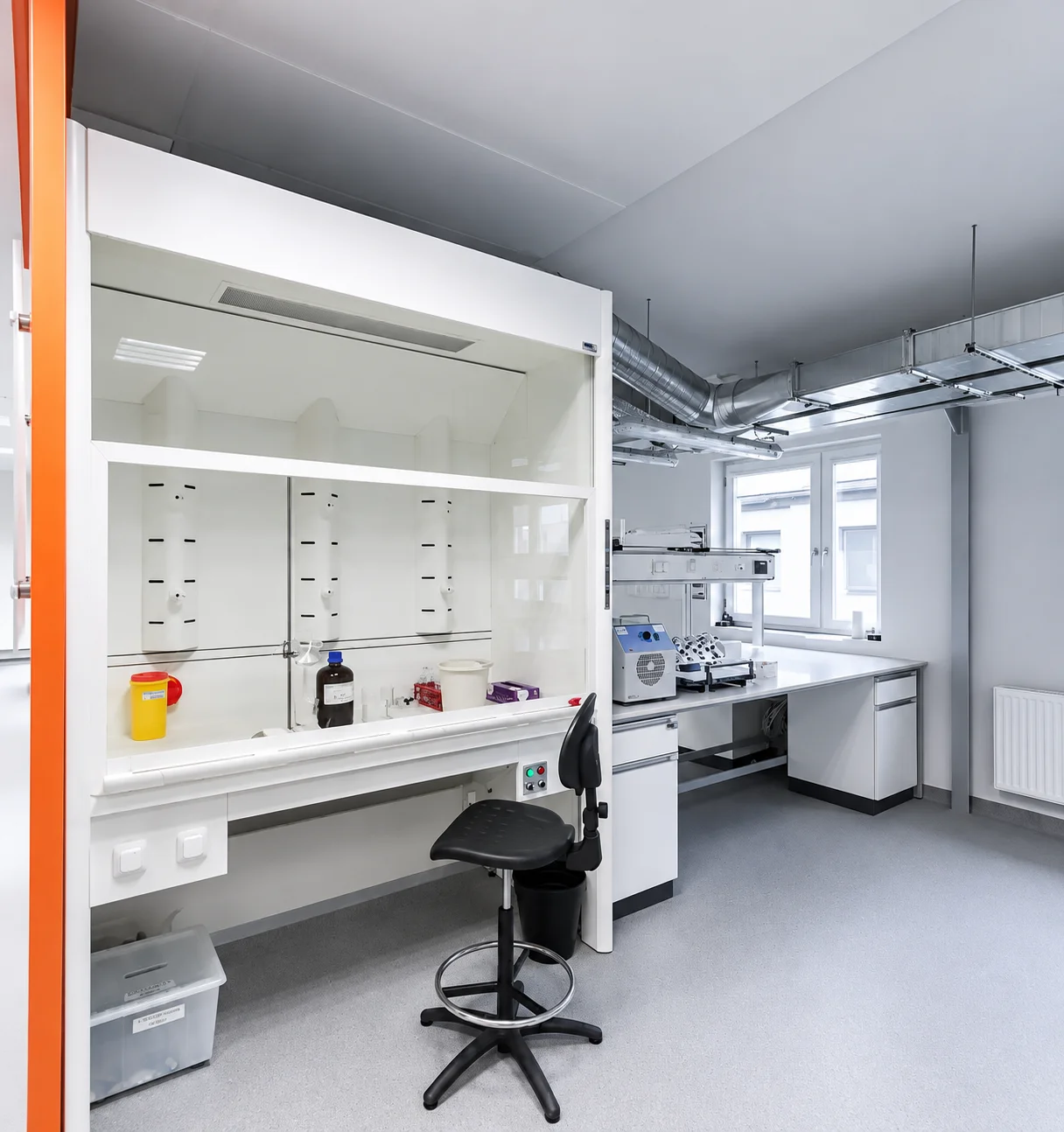
A bench for a dryer is chosen according to the weight of the device, the heat from its housing and access to a socket. In our answers to frequently asked questions, we state that a standard bench takes about 200 kg per running metre, and heavier devices require reinforcement. That is why a list of the equipment that will stand on the countertops is attached to a furniture enquiry.
For a hot device and the vessels taken out of it, we offer an epoxy resin countertop, which withstands a continuous thermal load of up to about 180 °C. Another option is a monolithic ceramic countertop, heat-resistant and acid-resistant, 20 mm thick.
Our benches stand on a powder-coated steel frame. Sockets at research workstations should have at least IP44 ingress protection, and in bench superstructures we route them together with the other services. We describe how to plan space for equipment before the cabinet layout is drawn up in our article on designing a laboratory around its equipment.
Frequently asked questions#
For drying samples, reagents and laboratory glassware at a constant, set temperature. Models that hold a sufficiently high temperature are also used for dry heat sterilisation and for heat-treating materials.
In a forced air dryer, a fan mixes the air, so the temperature in the chamber is more uniform and drying is shorter. A natural circulation dryer does not disturb the load, which is why it is chosen for light and powdery samples.
A convection or forced air dryer, with shelves or baskets for the vessels. Volumetric glassware is not dried at elevated temperature, because heating can permanently change its volume (opens in a new tab).
Yes, if the dryer holds the temperature required for dry heat sterilisation. According to the PSSE Gniezno instructions (opens in a new tab), at 160 °C the process takes no less than 2 hours, not counting heat-up. The effectiveness of the cycle is confirmed with a biological test.
In a fluidised bed dryer, a stream of hot air lifts and mixes the particles of material, so they dry quickly and evenly. In batch drying, one portion goes through the whole cycle, while in continuous drying, material constantly flows into and out of the bed.
Temperature range, chamber capacity and temperature uniformity matched to the load. In addition, independent overheating protection, a programmable cycle and temperature logging when the laboratory documents the process.