Laboratory Glassware - Types, Applications and Quality Standards
Laboratory glassware covers vessels made of glass that resists reagents and heat. Item names and uses, volumetric and non-volumetric glassware, Class A and B.
 Renggli TeamEditorial team
Published: Updated Reading time: 8 min read
Contents
Laboratory glassware consists of vessels and instruments made of glass that resists reagents and temperature changes, most often borosilicate glass, used to measure, mix, heat and store substances. It is divided into volumetric glassware, for measuring volumes accurately, and non-volumetric glassware. After use, glassware is washed, dried and put away in laboratory furniture: at the sinks, in cabinets and on the shelving units above the countertop.
What are the types of laboratory glassware?#
Laboratory glassware is classified by material into borosilicate, soda-lime and quartz glass, and by purpose into volumetric and non-volumetric glassware. The American standard ASTM E438 (opens in a new tab) lists three types of glass for laboratory apparatus: low-expansion borosilicate, aluminoborosilicate and soda-lime glass.
Borosilicate glass copes well with heating and sudden temperature changes because it expands very little when heated. Borosilicate glass 3.3 is described in ISO 3585:1998 “Borosilicate glass 3.3, Properties” (opens in a new tab). It is used for beakers, flasks and test tubes that go over a burner, into a bath or onto a hot plate.
Soda-lime glass expands more with heat than borosilicate glass, so it tolerates rapid heating and cooling less well. Quartz glass is chosen for work at high temperatures and for cuvettes that UV radiation has to pass through. Amber (brown) bottles protect reagents that decompose when exposed to light.
Glass stands up well to acids, alkalis and solvents, but not to hydrofluoric acid. HF reacts with the silica in glass and permanently damages its surface, so plastic vessels are used when working with it.
What are the names of laboratory glassware items and what are they used for?#
Each piece of laboratory glassware has its own name and one main job: mixing, heating, measuring, filtering, distillation or storage. The table lists the most commonly used glassware and shows whether each item is volumetric.
| Item | What it is used for | Volumetric |
|---|---|---|
| Beaker | mixing, heating, preliminary preparation of solutions | no, the graduations are approximate |
| Conical (Erlenmeyer) flask | mixing without splashing, titration, work with a magnetic stirrer | no |
| Round-bottom flask | heating, distillation, reactions under a condenser | no |
| Test tube | small-scale reactions and tests | no |
| Petri dish | culturing microorganisms | no |
| Watch glass | weighing small quantities, covering a beaker, evaporating a drop of solution | no |
| Crystallising dish, evaporating dish | crystallisation and solvent evaporation | no |
| Filter flask (Büchner flask) | filtration under reduced pressure | no |
| Liebig condenser | condensing vapours during distillation | no |
| Separatory funnel | separating immiscible liquids | no |
| Desiccator | drying and storing substances in a dry atmosphere | no |
| Measuring cylinder | quick measurement of volume | yes, less accurate |
| Volumetric flask | preparing a solution of exact concentration | yes |
| Volumetric (bulb) pipette and graduated pipette | transferring an exact volume of liquid | yes |
| Burette | dispensing titrant during titration | yes |
| Pycnometer | determining the density of liquids and solids | yes |
Other common items are reagent bottles, weighing bottles, glass stirring rods, funnels, microscope slides and cover slips, and Kipp’s apparatus for generating gases.
What is the difference between volumetric and non-volumetric glassware?#
Volumetric glassware has a mark or graduations calibrated to show volume within a specified error, while non-volumetric glassware is for handling liquids without precise measurement. The graduations on a beaker or conical flask only help to estimate the amount.
Volumetric glassware is calibrated either to contain or to deliver. A volumetric flask contains its nominal volume when the meniscus touches the mark. A pipette and a burette deliver their nominal volume, and the thin film of liquid left on the walls is already accounted for in the calibration.
One-mark volumetric flasks are covered by PN-EN ISO 1042:2002 “Szklany sprzęt laboratoryjny. Kolby pomiarowe z jedną kreską” (opens in a new tab) (the Polish edition of EN ISO 1042, “Laboratory glassware. One-mark volumetric flasks”). According to the standard’s entry in the catalogue of PKN (the Polish Committee for Standardization), such flasks are used to prepare standard solutions. A measuring cylinder is convenient, but standardised solutions call for a volumetric flask and a pipette.
The reading depends on the meniscus: the eye is held level with the mark, and the bottom edge of the meniscus of a clear liquid is brought down to the mark. Any reading error carries over into the concentration of the solution and the result of the analysis. Volumetric glassware is not scrubbed with a brush or abrasive powder, because scratches on the walls retain liquid and change the volume of the vessel.
What is the difference between Class A and Class B volumetric glassware?#
Class A is volumetric glassware with tighter permissible volume errors, while Class B is general-purpose glassware of the same design with wider tolerances. According to ASTM E288 (opens in a new tab), Class B tolerances for volumetric flasks fall within a range twice as wide as for Class A. A Class A flask carries the letter “A” on the glass.
Class A is chosen for quantitative analysis, standard solutions and titration when the result goes into a report. Class B is sufficient for routine work, for preparing auxiliary solutions and in teaching laboratories.
Volumetric glassware is calibrated at a specified temperature. According to ASTM E287 (opens in a new tab), burettes are calibrated to deliver their nominal volume at 20 °C. That is why solutions are measured out at room temperature, and volumetric glassware is never heated over a burner or on a hot plate.
What furniture do you need for washing, drying and storing laboratory glassware?#
Laboratory glassware needs a washing station with a reagent-resistant sink, a place to dry and lockable cabinets where it can be stored safely. We do not make glassware, but in Białystok we manufacture the laboratory furniture it is used on.
For the washing area we offer laboratory sinks in monolithic ceramic, epoxy resin, polypropylene or stainless steel, with one or two bowls. Some models also have a draining board where washed glassware dries. For faster drying there is the laboratory dryer.
A glassware washing area is planned along a wall with a water supply and a drain, with countertop on both sides of the sink. Dirty glassware stands on one side and washed glassware on the other, so clean items never go back onto the dirty part of the countertop.
If the laboratory uses hydrofluoric acid, we offer a countertop and sink made of polypropylene. Polypropylene is resistant to acids and alkalis, HF included, and the sink is built into the countertop by injection moulding, with no seam.
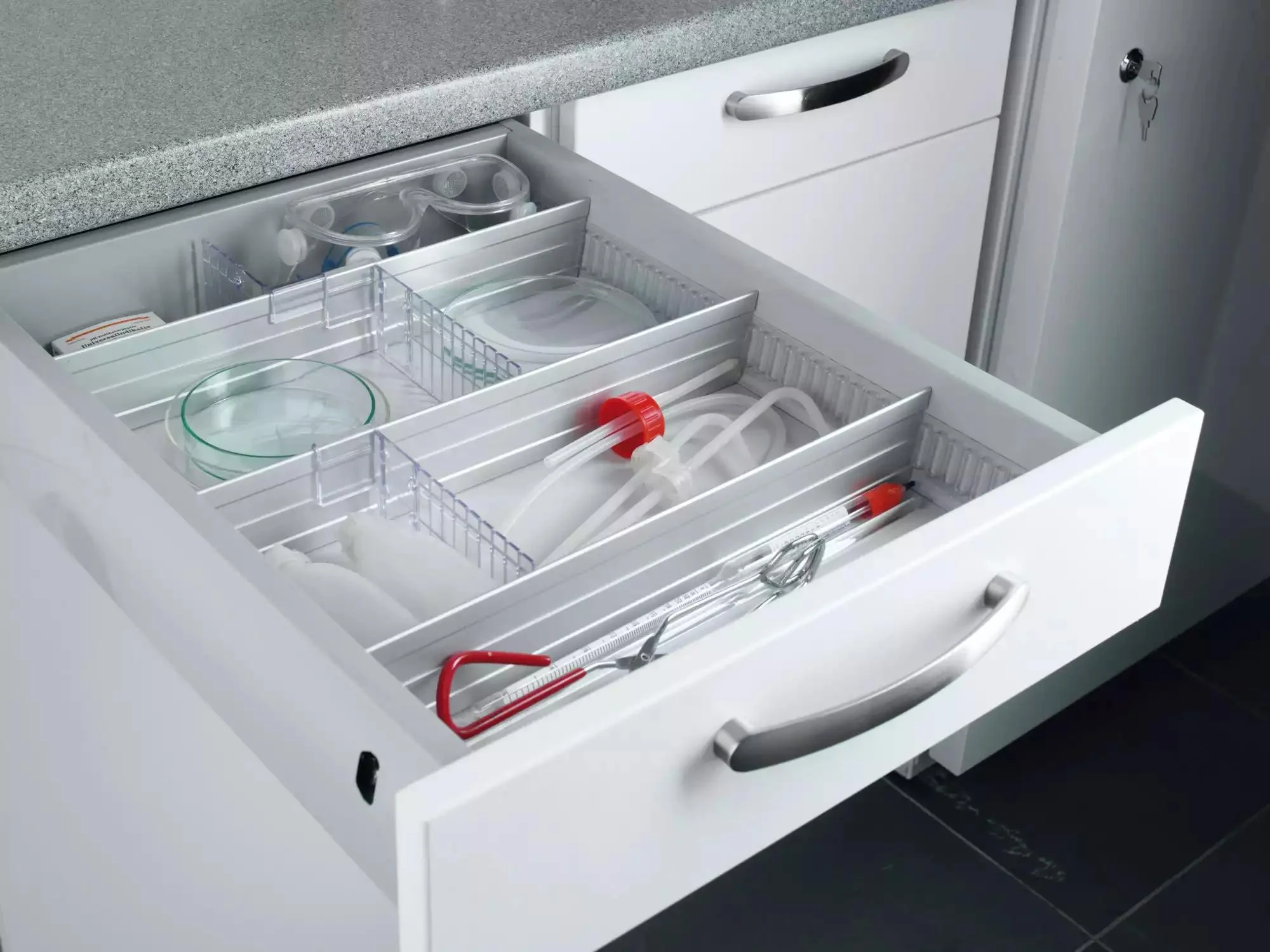
Clean glassware is put away in under-counter cabinets with drawers and doors, in wall cabinets or on the shelving units above the countertop. Bottles of acids and alkalis are kept in an acid and alkali storage cabinet compliant with EN 16121 and EN 16122. The cabinet has pull-out shelves with spill trays. Glass apparatus for distillation and for work with volatile reagents is set up in a fume hood.
How much space the washing area, draining boards and cabinets take up depends on the amount of glassware and apparatus. That is why designing a laboratory around its equipment starts with a list of equipment, and the furniture layout is based on it.
Frequently asked questions#
Beakers and conical flasks are used for mixing, round-bottom flasks and condensers for distillation. Test tubes are used for small-scale tests, and Petri dishes for cultures. Volumetric flasks, pipettes, burettes and measuring cylinders are used to measure volumes.
Volumetric glassware has a mark or graduations calibrated to a specified permissible error, so it is used to measure volumes accurately. Non-volumetric glassware, such as a beaker or a conical flask, has approximate graduations at most and is used for mixing, heating and reactions.
A watch glass is used to weigh small quantities of a substance, to cover a beaker against dust and splashes, and to evaporate a drop of solution. Its curved shape collects the substance in the centre of the glass.
It is a round-bottom flask. The round bottom heats up evenly, so the flask is used for heating and distillation, usually in a heating mantle or a bath.
Laboratory glassware is made by technical glassworks, and the class of a volumetric item is given by the marking on the glass. Renggli manufactures laboratory furniture in Białystok: benches, cabinets, sinks and storage cabinets where glassware is washed, dried and stored.