Choosing medical furniture - how to choose the right office equipment?
The choice of equipment for a medical facility is a decision that affects not only the comfort of the staff's work, but above all the safety of patients and the fulfilment of sanitary requirements. Well-chosen medical furniture is durable and, in all rooms of the facility except administrative and staff rooms, can be cleaned and disinfected, as the Polish regulation on the premises of healthcare providers requires.
 Renggli TeamEditorial team
Published: Updated Reading time: 5 min read
Contents
Medical furniture is chosen for the room and the work done in it: a doctor's office needs different cabinets from a treatment room or a hospital room. Polish regulations require furniture in a healthcare facility to be washable and disinfectable. When choosing, the material, dimensions, locks and the documents to ask the supplier for tell you the most.
What standards and certificates must medical furniture meet?#
The basic requirement for medical furniture comes from the Polish Minister of Health regulation on the premises and equipment of healthcare providers (Journal of Laws 2022, item 402). Under § 27, furniture in a facility's rooms must allow washing and disinfection. It applies to all rooms except administrative and staff rooms and psychiatric and addiction treatment clinics.
Enquiries about medical furniture also mention ISO 13485. In Poland it is published as PN-EN ISO 13485:2016-04, “Medical devices. Quality management systems. Requirements for regulatory purposes”. According to the standard's page in the PKN catalogue, it sets requirements for the quality management system of organisations that design, produce, distribute or service medical devices. It therefore covers processes in a company; it does not describe the dimensions of a cabinet or how a countertop stands up to disinfection.
Because the regulation describes a property of the furniture, it helps to say which documents you mean when asking for a “certificate”. For medical furniture, the most useful are:
a technical drawing with the dimensions and layout of cabinets, drawers and countertops;
a description of the material of each surface (stainless steel, powder-coated sheet steel, laminated board) with the agents that may be used to disinfect it;
the warranty terms and the scope of installation.
On delivery, the furniture is checked against the drawing and the material description, and in a complaint the same documents show what was ordered.
What are the most important criteria for choosing medical furniture?#
Five things matter when choosing medical furniture:
- Ergonomics and functionality. The height of countertops, the depth of cabinets and the drawer layout are matched to the tasks staff perform most often. Lockable castors let a cabinet or side table be moved next to the examination couch and fixed in place during a procedure.
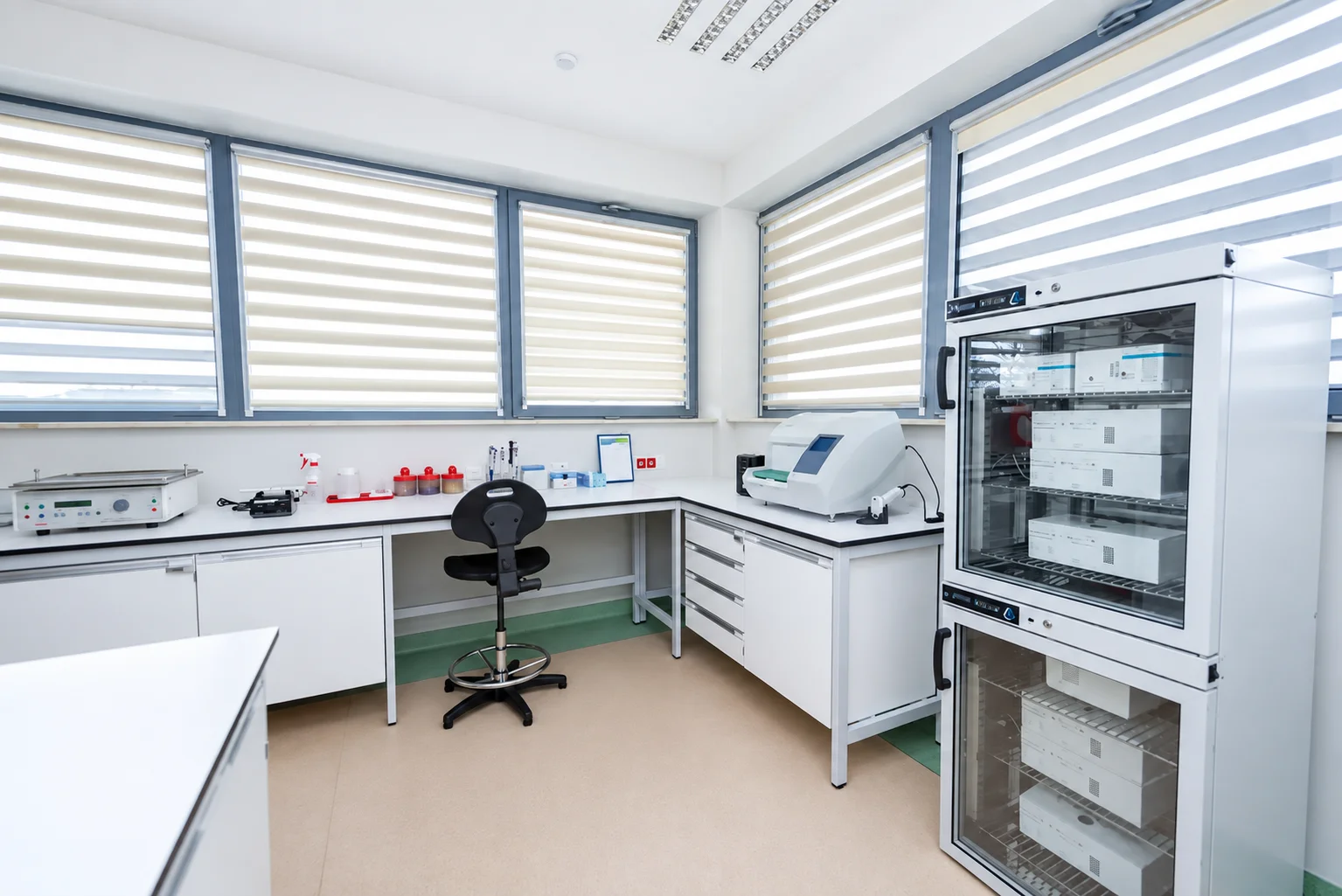
- Durability and build quality. Furniture in a doctor's office is cleaned every day, so durability depends on the material, edges, hinges and handles. A room where staff work with chemical reagents needs laboratory furniture with chemical-resistant countertops.
- Easy to disinfect and hygienic. A smooth, non-porous surface without gaps withstands daily disinfection more easily. The agent is chosen for the material: stainless steel is cleaned with alcohol-based or active-oxygen products, while chlorine agents are used only well diluted and rinsed off thoroughly.
- Aesthetics and image of the institution. Colour changes how patients see a room. Medical carts, bedside cabinets and side tables in hospital rooms can be made from laminated board in various colours instead of plain white.
- Price and quality. The price of medical furniture depends most on the material, sheet thickness and type of coating, the dimensions and extras such as locks, glazing and filing drawers. Stainless steel costs more as a raw material than powder-coated sheet steel, so it usually goes only into the zones that need it.
What materials are medical furniture made of?#
Medical furniture is most often made of stainless steel or powder-coated sheet steel. Stainless steel has a smooth, non-porous surface that is easy to clean and disinfect, and grades with added molybdenum resist pitting corrosion better. How to plan a room with stainless steel medical furniture is covered in a separate guide.
Stainless steel is chosen where a surface is in daily contact with water and disinfectants: at the washbasin, on work countertops and in treatment room cabinets. Powder-coated sheet steel is enough in the consulting room, reception and archive, where furniture is cleaned regularly but does not stand in moisture.
Bedside cabinets, medical carts and staff kitchen units also use laminated board.
What furniture is necessary in a doctor's and treatment office?#
A doctor's office needs a desk, an examination couch or table, a medicine cabinet and a cabinet for records. Which equipment in a doctor's office is mandatory depends on the type of services and the rules for the facility.
A treatment room adds a treatment table, instrument trolleys on castors and a work countertop by the washbasin. Under § 37 of the regulation, a room where examinations or procedures are performed has a washbasin with hot and cold water, so the units are planned around it.
In a hospital room, bedside cabinets stand next to the patient's bed, and staff work with medical carts and medication trolleys.
Height adjustment and lockable castors are useful in each of these rooms. Wall-mounted cabinets or cabinets on high legs leave the floor clear, which makes it easier to clean.
How to safely store medicines and medical records?#
Medicines and medical records are kept in lockable furniture that unauthorised people cannot access.
Medical cabinets for medicines have lockable compartments, shelves or drawers and surfaces that withstand disinfectants. Glazed doors made of safety glass let staff check stock without opening the cabinet.
Thermolabile medicines are kept in a refrigerated cabinet at +2 °C to +8 °C, and narcotics in a separate, lockable metal cabinet or a safe. How to choose compartments, locks and dimensions is covered in our guide to choosing a medical cabinet for medicines.
Paper medical records are kept in lockable filing cabinets or on shelving in a locked archive. The GDPR requires patient data to be protected from unauthorised access, so record cabinets are locked too.
Is it worth ordering custom-made medical furniture?#
Custom-made medical furniture pays off in small and irregular rooms and where the units take in a washbasin, utilities and several workstations. Made-to-measure units use recesses and corners without dead zones where dirt collects. In a diagnostic laboratory, laboratory chairs are also matched to the countertop height.
The starting point is a floor plan of the room or its dimensions, a list of workstations and information on utilities. With a furniture order, we prepare the design free of charge: our designer takes the measurements, and the customer receives technical drawings in PDF and 3D visualisations in JPG.
Mobile cabinets and modules on castors make it possible to change the layout of a room later without rebuilding all the units.