Ventilated chemical cabinet - when is it needed?
Safety at work in the laboratory starts at the equipment selection stage. Proper storage of reagents is not only about keeping shelves tidy, but above all about protecting the health of staff who have daily contact with volatile and irritating substances. Improper chemical storage conditions also harm the infrastructure. Corrosive vapors damage equipment and electrical installations. A ventilated chemical cabinet reduces this risk by combining the storage function with active vapor extraction outside the work zone.
 Renggli TeamEditorial team
Published: Updated Reading time: 8 min read
Contents
What is a ventilated chemical cabinet and how does it work?#
A standard laboratory cabinet serves purely a storage function; it separates reagents from the environment but does not affect the air quality inside. A ventilated chemical cabinet differs fundamentally: it has a forced air circulation system that continuously removes vapors accumulating in the chamber.
Ventilation can be achieved in two ways: by connecting the chamber to the facility's exhaust system, which discharges air outside the building, or by using an independent fan with a filter that neutralizes vapors at their source. The choice between the two methods depends on whether the building has an exhaust system with enough capacity reserve to serve an additional ventilated cabinet.
The forced airflow typically moves the air from the bottom to the top of the chamber. Vapors escape through connection spigots in the upper part of the structure and go to the exhaust system or to a filter. A top-mounted filtering (recirculation) module cleans the air and returns it to circulation in the room instead of discharging it outside.
Crucial here is the continuous air exchange in the chamber, maintained at a specific, minimum air exchange rate per hour, ensuring that the concentration of volatile substances does not reach dangerous levels. The vapor extraction works regardless of whether the cabinet doors are open or closed, distinguishing it from a fume hood designed for working with open vessels.
Seals and the precise fitting of components give the chamber high tightness, so the extraction captures gases effectively and the system runs quietly. Some designs include an airflow monitoring module that continuously checks the exhaust parameters. If the extraction efficiency drops below a safe level, the module immediately triggers an acoustic and optical alarm.
When is a ventilated cabinet in a laboratory absolutely necessary?#
The decision to use a ventilated cabinet should stem from the characteristics of the substances used in the laboratory. If volatile reagents emitting intense vapors or a distinct, irritating odor are stored in the workspace, a standard closed cabinet will not provide sufficient protection; vapors will accumulate inside and be released every time the door is opened.
The second criterion is the risk of corrosion to equipment located in the same room. Vapors from acids or halogenated compounds can damage metal parts of the apparatus, electrical contacts, and ventilation systems. Ventilated chemical storage limits vapor migration into the environment and extends the lifespan of the equipment.
Respiratory protection of the personnel is a third, equally important argument. Even brief, repeated exposure to low concentrations of harmful vapors can lead to irritation of mucous membranes or headaches, and in the long term, to chronic respiratory diseases.
Therefore, the necessity of using a ventilated cabinet is determined by a combination of three factors: the volatility and toxicity of the substances, the presence of corrosion-sensitive equipment in the vicinity, and the frequency of personnel contact with a given storage zone.
What substances require storage in extraction cabinets?#
Acids and bases are among the substances that most often require storage in extraction cabinets. Their vapors are harmful to the respiratory tract and highly corrosive, which is why such cabinets should be made of chemically resistant materials, acid-resistant plastics, or properly protected sheet steel.
Another category is organic solvents, classified as volatile organic compounds (VOCs). They are characterized by high vapor pressure, meaning rapid evaporation even at room temperature, which without adequate ventilation risks exceeding permissible concentration limits in the air.
Continuous extraction prevents solvent vapors from building up in the chamber and in the room, so with flammable substances it also reduces the risk of an explosive atmosphere forming.
Toxic and carcinogenic substances require special attention regardless of the frequency of use. Even minor, long-term exposure to their vapors can carry serious health consequences, which is why storing them in a forced-air circulation cabinet should be standard practice.
It is worth distinguishing between two solutions: a standard ventilated cabinet extracts vapors and protects against inhaling them, while a fire-resistant cabinet additionally protects against fire and is intended for flammable liquids, e.g., solvents with a low flash point.
Reagent cabinet, acid and base cabinet, or fire-resistant cabinet?#
These three types of cabinets differ in how their interiors are equipped:
- A ventilated reagent cabinet is a universal solution for less aggressive substances. It extracts vapors from typical reagents and keeps everyday preparations in one easily accessible place.
- A cabinet for acids and bases has an interior lined with chemically resistant material, most often polypropylene (PP), which is inert to highly corrosive vapors. Inside are pull-out PP trays with a raised edge. If a container breaks, the tray retains the liquid and prevents it from mixing with other reactive chemicals.
- A fire-resistant cabinet for flammable substances has a certified fire resistance class, e.g., Type 90, which means 90 minutes of protection in fire conditions. It has an integrated ventilation system, and when the ambient temperature rises, the doors seal automatically and the ventilation valves close.
Ordinary steel degrades quickly when exposed to vapors, which is why chemical cabinets use epoxy coatings, acid-resistant steel, and high-density plastics such as polypropylene. The resistance of the material determines whether guides, hinges, and locking systems will work smoothly throughout the entire period of operation. A reagent spilled in a cabinet made of non-resistant material leaves rust spots that weaken the load-bearing capacity of the shelves.
Types of ventilated cabinets and their integration with laboratory furniture#
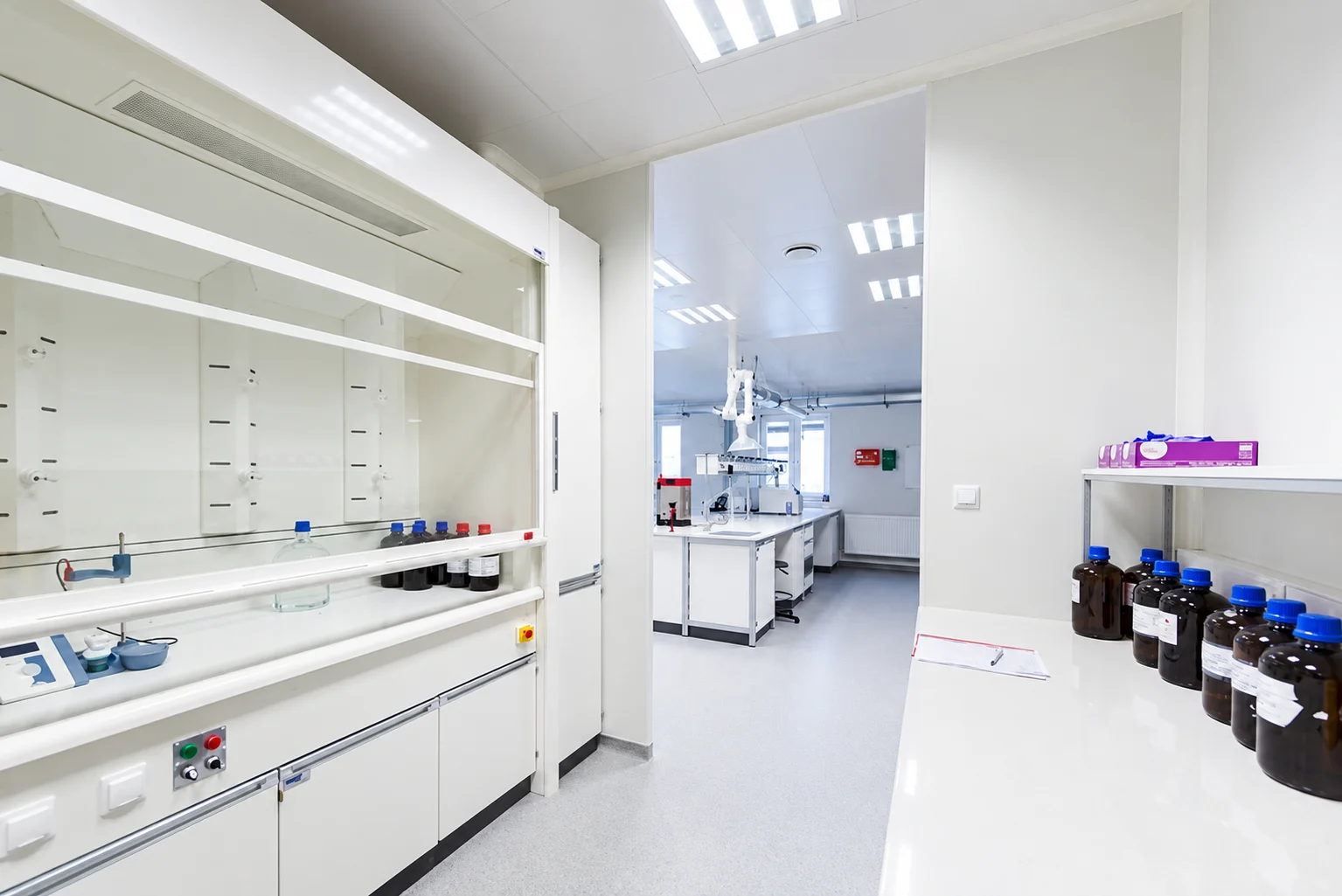
Ventilated cabinets come in several structural variants. Tall freestanding cabinets work well where larger quantities of reagents need to be stored, while under-bench cabinets mounted under fume hoods allow for the utilization of space at the workstation, shortening the transport route for hazardous substances.
The position of the cabinets is set as early as the room layout planning stage. The chemical storage zone is separated from office work zones and evacuation routes, and the cabinets are placed close to workstations and fume hoods, with clear passages maintained. The reagent then travels a shorter distance, so containers are dropped or spilled less often.
Regardless of the type, the consistency of the cabinet with the rest of the laboratory furniture infrastructure is of key importance. The vapor extraction system should be integrated with the building's general ventilation installation in such a way as not to disturb the air balance or generate excessive noise.
Increasingly, laboratory designers opt for modular solutions, adapted to existing furniture lines, as in systems based on the RL module, where ventilated cabinets naturally complement worktops, base cabinets, and shelving. Modularity allows for future expansion without replacing all the equipment.
The aesthetics of the finish are not a secondary issue. A uniform appearance of the fronts, consistent colors, and precise adjustment of the cabinet dimensions to the rest of the furnishings influence the professional perception of the workspace, which matters during both audits and client visits.
How is a ventilated cabinet connected to the building's ventilation system?#
The air extracted by cabinets and fume hoods must be continuously replaced by supply air. If the balance is disturbed, negative or positive pressure builds up in the laboratory. Doors then become difficult to open, and pollutants from other zones of the facility may be drawn into the room.
Chemically resistant ventilation ducts run from the cabinet to the exhaust system. The airflow is regulated by a constant air volume (CAV) or variable air volume (VAV) system. Well-chosen regulation reduces energy consumption in the building, while extraction from the interior of the cabinets runs without interruption.
OHS regulations and safety standards versus laboratory equipment#
Working with chemical agents is subject to general OHS regulations, which impose an obligation on the employer to ensure appropriate storage conditions for hazardous substances and to limit personnel exposure to harmful vapors. Rules on the storage of hazardous substances in the laboratory also require segregation of incompatible reagents, so a ventilated cabinet does not replace separating acids from bases.
Storing hazardous substances on the bench or in an ordinary, unventilated cabinet violates safety procedures, because vapors are then released into the room without any control.
Laboratory furniture, including reagent storage cabinets, should meet the requirements of the EN 14727 standard, and fire-resistant models intended for flammable liquids must additionally meet the EN 14470-1 standard. Compliance with these standards confirms the structural durability and effectiveness of the ventilation solutions.
The lack of a properly selected cabinet is not only a threat to staff health but also a legal and financial risk. During a safety audit, equipment non-compliance with standards and OHS regulations may result in the costly replacement of furniture and, in extreme cases, the suspension of the laboratory's operations.
Renggli solutions - tailor-made precision and safety#
Renggli, as a laboratory furniture manufacturer and an entity implementing comprehensive laboratory projects, offers advisory support at the stage of selecting appropriate ventilated cabinets for the specific nature of a given laboratory. This selection takes into account both the type of stored substances and the characteristics of the existing ventilation installation in the building.
The offered solutions are designed with integration into the building's general ventilation systems in mind, avoiding installation conflicts and ensuring stable fume extraction operation regardless of the load on the entire laboratory ventilation network.
The high quality of the materials used and the ergonomics of the design are adapted to the specific nature of the industry for which the laboratory is built, ranging from pharmaceutical and biotechnological facilities, through research centers, to heavy industry plants, where the scale and intensity of chemical use can be significantly greater.